Companies usually start an office search by choosing a location. The decision that should come first is the type of office, because it governs cost, speed, and how much of the work the company has to run itself.
The building is visible. The operating model behind it is what actually shapes the commitment. Office space in India is often narrowed to a question of city and rent. That skips the structurally prior question, which is what kind of office the company actually needs.
A traditional lease and a managed office can sit in the same building at the same rent and still represent completely different commitments, one requiring the company to build and run the space, the other handing that to an operator. The type decision shapes capital, speed, flexibility, and attention more than the address does.
The market has widened precisely because occupiers want to make that choice deliberately. The CBRE Industry Report prepared for Table Space (August 2026) documents flexible workspace becoming a mainstream enterprise choice in India, led by technology and finance, as companies move away from self-run leases toward models that outsource the non-core work of running an office.
This guide sets out the main types and when each fits.
What Is an Office Space?
An office space is any workplace a business occupies to run its operations, but the types differ along a few axes that decide the commitment: who owns the fitout and runs the facilities, how long the contract runs and how flexibly it scales, how much capital goes in upfront, and how fast the space is ready to use. Understanding a type means understanding where it sits on those axes, not just what the room looks like.
Types of Office Spaces in India
Managed Office
A managed office space is private, branded space taken on a longer-term basis but built and run by an operator. The occupier gets a dedicated, customised office without commissioning the fitout or running facilities, and pays a single fee that bundles space, services, and operations.
It suits enterprises and GCCs that want a bespoke office at scale without the capital and burden of building one.
Serviced Office
A serviced office is a ready-to-use, fully serviced workspace rented with flexible terms, typically within a shared building managed by an operator. Furniture, utilities, reception, and maintenance are included, and the occupier can move in quickly.
It suits smaller teams, short commitments, and companies that prioritise speed and flexibility over a fully bespoke environment.
Flex Office
Flex office is the broad category of flexible workspace, space taken on shorter, scalable terms rather than a conventional long lease, spanning managed, serviced, and coworking formats. The defining feature is flexibility of commitment and scale.
It suits organisations that need to expand or contract without renegotiating a decade-long lease each time.
Traditional Leased Office
A traditional leased office is bare or warm-shell space taken directly on a long lease, where the occupier funds the fitout and runs the facilities. It offers maximum control and, at large scale over a long horizon, can be cost-effective, but it commits significant upfront capital and loads the company with construction and operations.
It suits occupiers that want full control and have the capital and in-house capability to build and run space.
Coworking Space and Hot Desks
Coworking provides shared, membership-based workspace, including hot desks booked as needed rather than assigned. It is the most flexible and lowest-commitment format, with shared amenities and a community environment.
It suits freelancers, startups, small teams, and satellite workers who need desks without any fixed footprint.
Private and Dedicated Office
A private office space or dedicated office is space assigned exclusively to one company, whether inside a serviced building or as a standalone managed office. It gives privacy, security, and a controlled environment, unlike shared coworking.
It suits teams that handle confidential work or want a defined, branded space of their own.
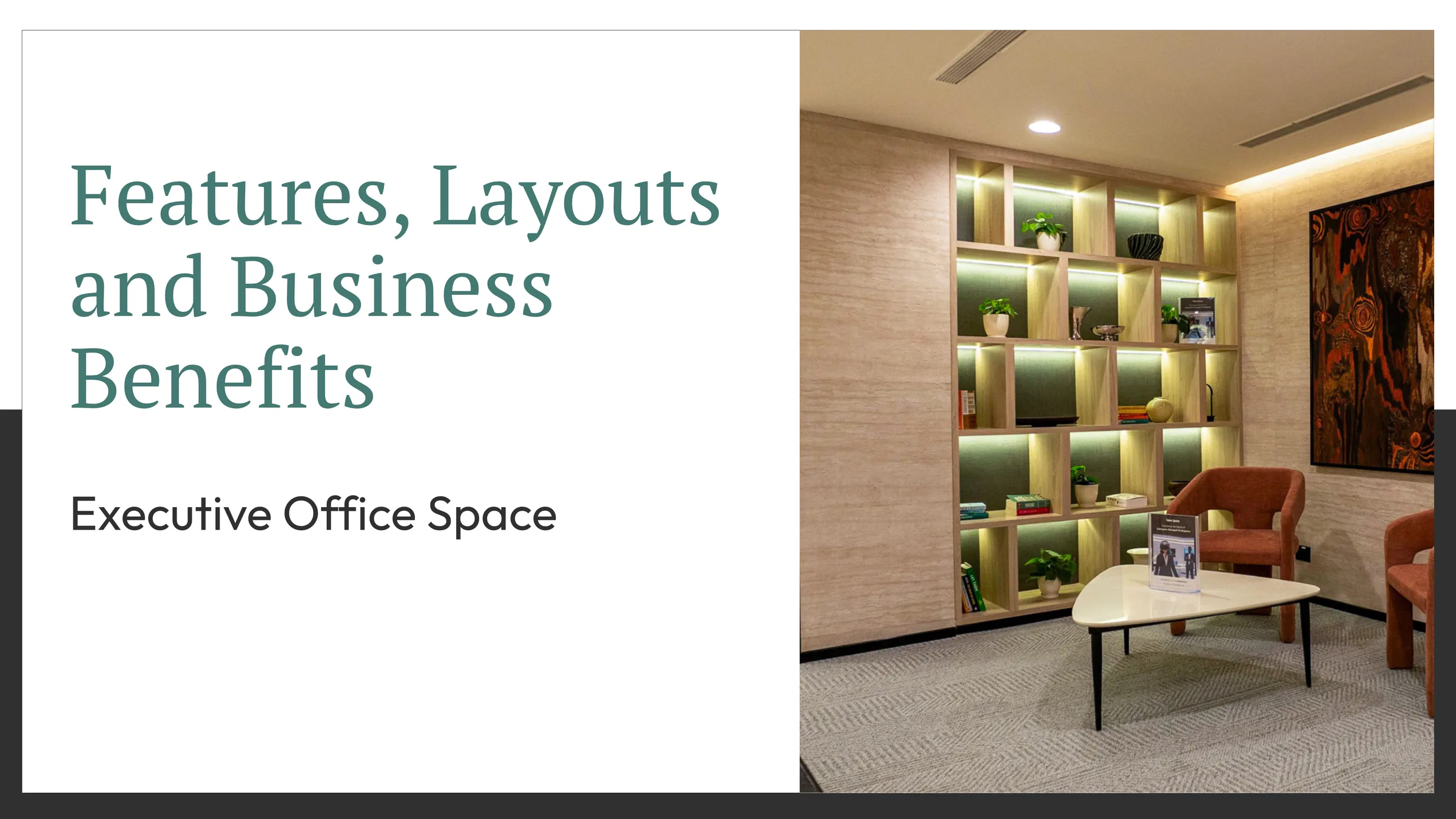
Executive Office Suites
Executive suites are premium, private, ready-to-use offices for leadership and client-facing teams, with higher finishes and support such as reception and boardrooms. They combine privacy and a professional hosting environment with the speed of a serviced product.
They suit senior leaders, client-facing functions, and regional or GCC heads.
Ready-to-Move-In (Plug-and-Play) Office
A ready-to-move-in office suite, or plug-and-play office, is fully fitted and furnished for immediate occupation, with no setup period. The occupier walks into a working office.
It suits companies that need space fast, are scaling quickly, or want to avoid any fitout timeline.
Custom-Built Office
A custom-built office is designed and constructed to the occupier's exact specification, either as a design-and-build mandate or as part of a managed arrangement. It delivers a fully bespoke environment.
It suits enterprises with specific brand, layout, or technical requirements that a standard product cannot meet.
Virtual Office
A virtual office provides a business address and associated services, mail handling, call answering, and meeting-room access on demand, without a permanent physical workspace. It suits company registration, establishing a presence in a city, and fully remote teams that occasionally need a professional address or meeting space.
Hybrid and Hub-and-Spoke Office
A hub-and-spoke model combines a central office (the hub) with smaller satellite locations (the spokes) closer to where employees live. It supports hybrid work by cutting commutes while keeping a central base.
It suits distributed organisations and enterprises optimising for talent access across a city or region.
Which Type of Office Space Is Best for Your Business?
The best type depends on four variables: how fast the space is needed, how much capital the company wants to commit upfront, how much flexibility it needs to scale, and how much of the running it wants to own versus outsource. A startup optimises for flexibility and low commitment; an enterprise or GCC optimises for a bespoke, compliant environment at scale without tying up capital in construction; a company entering a new city may want only a virtual office or a serviced suite first.
The table below maps the main types against the variables that decide the choice.
How to Choose the Right Type of Office Space
Choose by deciding the operating model before the location. Fix how much capital the company is willing to commit before the first employee sits down, how quickly the space must be ready, how much it needs to flex over the next few years, and whether running an office is work the company wants to do or outsource.
Those answers point to a type, and only then does the city and micromarket search begin. Reversing the order, choosing a building and forcing a model to fit, is how companies end up overcommitted on a lease they outgrow or underbuilt for the work they do.
The question we are asked is usually about location, but the decision that matters more is the type of office, because that sets the cost structure and the commitment. A company should decide how much it wants to own and how much it wants to outsource before it looks at a single building. Get the operating model right and the space serves the business; get it wrong and the business spends years working around a lease it should never have signed.
Karan Chopra, Chairman, Whole-time Director & Co-Chief Executive Officer, Table Space
Office Space Options With Table Space
Table Space covers the enterprise end of this range through managed offices, its Suites product for ready-to-move-in needs, and design-and-build mandates, so an occupier can take bespoke space at scale, a premium ready-to-use suite, or a custom build, all operator-run. For enterprises and GCCs, that means choosing the type that fits the requirement without taking on the fitout and facilities work themselves.
The footprint is the proof point. Table Space operates 176 facilities across nine cities, with 11.46 million sq ft of leasable area and 9.33 million sq ft leased as of March 31, 2026, the largest leased area among the operators benchmarked in the CBRE Industry Report (August 2026).
Its clients are principally Fortune 500 companies, GCCs, and multinationals, with 92.49% of leased area held by occupiers headquartered outside India (CBRE).
Deciding which type of office space fits your business? Talk to the Table Space team.