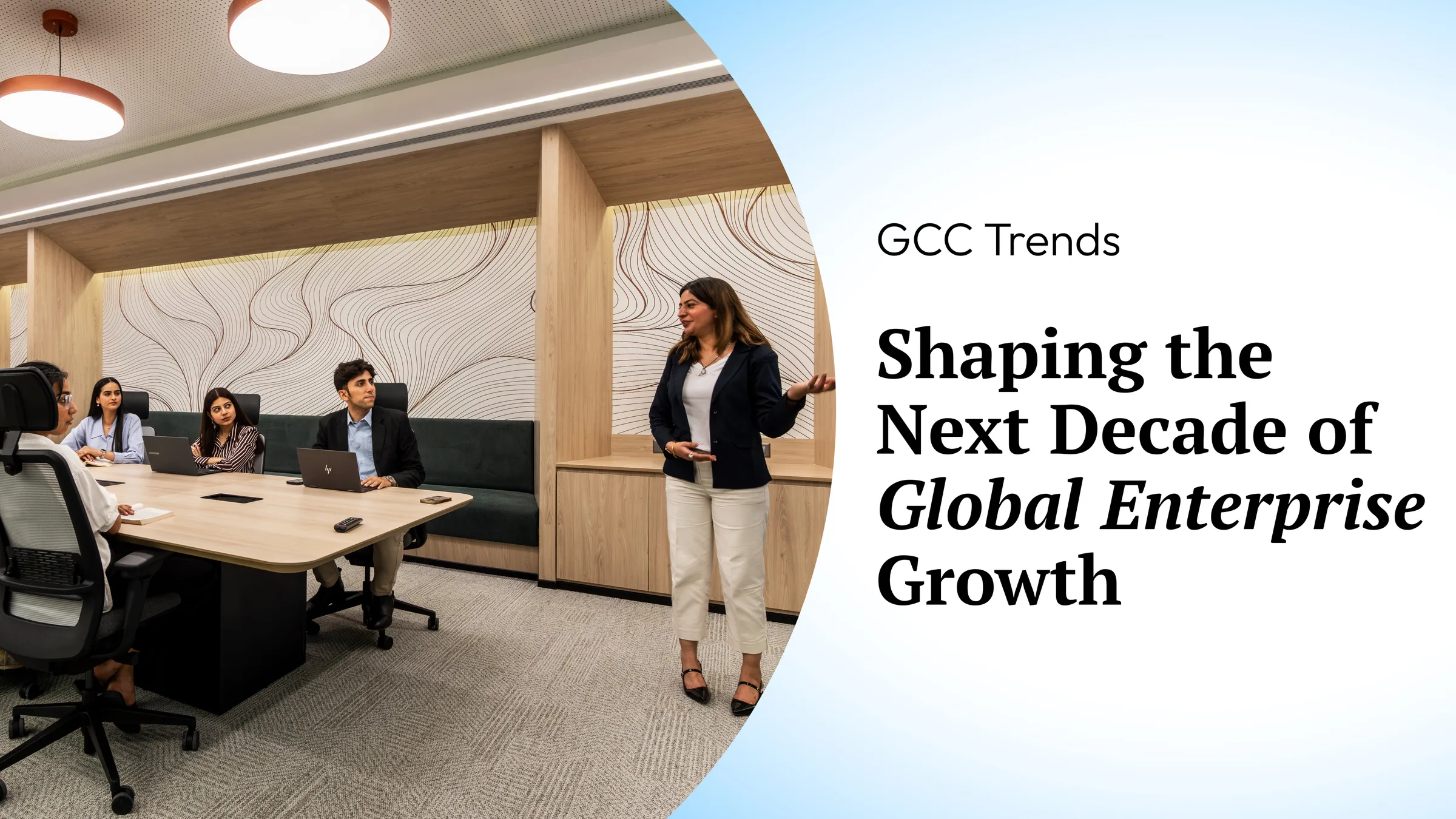

Most enterprises still track GCC trends by counting new centre announcements. The number that matters more is what those centres are being asked to own.
The scale of the shift is no longer a forecast. India hosts 1,760+ Global Capability Centres (GCCs) employing 1.9 million professionals, a base projected to reach 2,500+ centres contributing USD 105 billion to the global economy by 2030. A new GCC is established every 3 days. GCC trends for the next decade are less about whether enterprises build a centre and more about what mandate, footprint, and talent model that centre is designed around from day one.
Three forces are converging to redefine the category: real estate that behaves like infrastructure rather than a lease line item, a talent market that has matured past cost arbitrage, and a compliance bar that now sits at the centre of site selection rather than as an afterthought. Enterprises evaluating India in 2026 are reading these trends before they read a city shortlist.
What Is Driving GCC Growth Across India's Cities?
GCC growth is no longer concentrated in one or two metros. Hyderabad holds 20 to 23% of India's GCC market share in banking, financial services, and insurance (BFSI) and analytics, anchored by HITEC City, Kokapet, and Neopolis, and recorded the country's second-fastest delivery growth in financial year 2025-26 (FY 2025-26) at approximately 200% year-on-year. Bengaluru remains the largest single GCC market by leased footprint, spanning CBD, ORR, Whitefield, and Koramangala. Pune, Chennai, and the NCR corridor, including Noida's Sector 143A and Cyber City Gurugram, have all added meaningful GCC footprint within the same period.
Mumbai's delivery growth reached 250 to 300% year-on-year in FY 2025-26, the highest of any city, driven partly by expansion into Mindspace Airoli East and its Thane and Navi Mumbai talent catchment. Multi-city presence has stopped being a hedge and started being a strategy: each additional location strengthens talent access and business continuity for the others rather than simply adding square footage.
How Is Compliance Becoming a Core GCC Trend?
Buyer frameworks such as Service Organization Control 2 (SOC2), ISO 27001, the General Data Protection Regulation (GDPR), and the Health Insurance Portability and Accountability Act (HIPAA) have moved from a legal afterthought to a site-selection filter. GCC-ready infrastructure now means a dedicated network perimeter, private server infrastructure, and documented physical access controls that are audit-ready from day one, not retrofitted after occupancy. Coworking environments do not meet this bar structurally: a shared network perimeter covers every tenant on the floor, and no amount of configuration resolves that for a regulated buyer.
Post-handover commitments are following the same trajectory. Enterprises now expect a dedicated account manager before go-live, structured hypercare through the first 90 days, and quarterly service level agreement (SLA) reviews with documented performance reporting, built into the contract rather than negotiated after a problem surfaces.
Why Is Speed Becoming a Non-Negotiable GCC Trend?
Enterprises building capability centres are compressing timelines that used to run 12 to 18 months into a fraction of that. The delivery standard for a mid-sized requirement now runs approximately 90 days from letter of intent to operational handover, extending to 120 to 150 days above 100,000 sq ft. One Fortune 500 technology GCC delivered an 8,000-seat expansion across 3 cities in under 10 months, with cost outcomes 15 to 20% below the client's self-managed benchmarks.
That speed is structural, not a function of working harder. It comes from a single accountable provider running site identification, interior design, construction, IT infrastructure, facilities management, and account management as parallel workstreams instead of a sequential chain of separate vendors.
"Every enterprise we work with asks the same underlying question now, regardless of sector: how fast can this centre be operational, and how much of that timeline is actually in our control. The GCCs that scale fastest are the ones where a single provider owns every stage of delivery instead of coordinating six."
Krishnaswamy Nagarajan, Chief Operating Officer
How Is the Flex and Managed Workspace Market Shaping GCC Trends?
The CBRE-FICCI "Flex-plosion: India's Flexible Workspaces Era" report (March 2026) puts national flex stock at 110 to 114 million sq ft, growing at a 23 to 25% compound annual growth rate (CAGR) since 2020 across 500+ operators and roughly 2,600 centres. Global companies account for 55 to 60% of that demand. Flex penetration has reached 12 to 16% in Bengaluru and Pune specifically, well above the national Grade A average of 8 to 10%.
This maturity matters because it has changed what flex means for a GCC. Ready-to-move-in Suites, enterprise-configured and compliance-ready with occupancy inside 24 hours of a decision, are explicitly not coworking, and enterprises increasingly use them as bridge capacity while a larger custom-built centre is under construction.
What GCC Trends Should Enterprises Plan Around for the Next Decade?
Four patterns are likely to hold through 2030. First, mid-sized entrants with revenues between USD 500 million and USD 5 billion will keep growing as a share of new GCC formation, moving the market past the assumption that GCCs are a large-enterprise exercise. Second, multi-city footprints will become standard risk management rather than an expansion afterthought. Third, compliance certification will shift earlier in the site-selection process, ahead of cost and location in many cases. Fourth, delivery speed will keep compressing as procurement networks mature; Table Space alone runs a network of 1,250+ pre-qualified suppliers with forward rate contracts on standard materials.
The centres that define the next decade of GCC growth will not simply be larger versions of today's. They are being built with the compliance stack, the multi-city logic, and the delivery discipline in place from the first day of design, not added after the first audit.
Planning a GCC strategy around where the market is heading, not where it has been? Talk to the Table Space team.