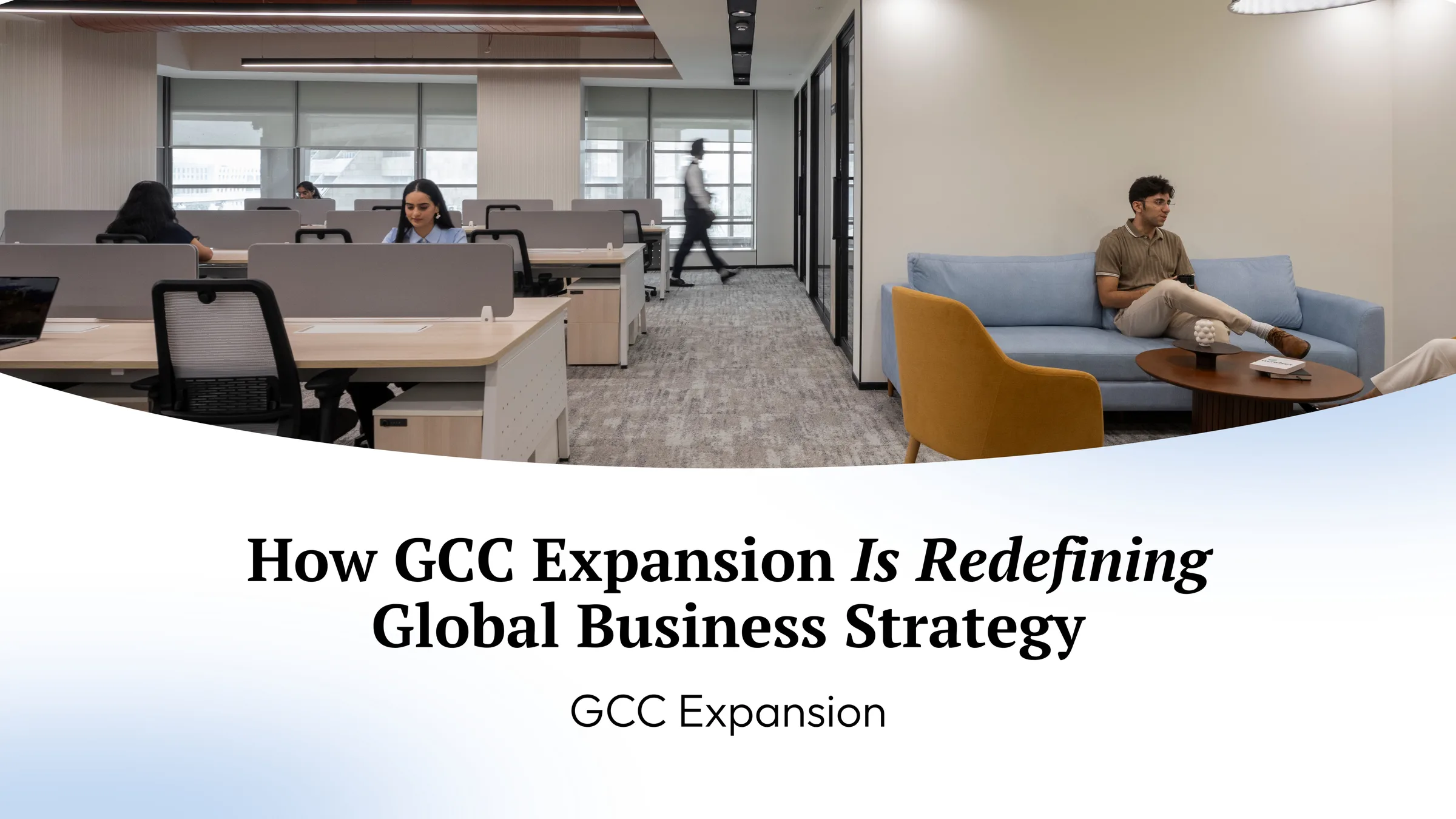

Enterprises used to expand into India by opening one centre and waiting to see what it proved. GCC expansion today starts with the multi-city footprint already designed.
GCC growth in India has moved past the pilot phase entirely. Global Capability Centres (GCCs) accounted for 37.7% of leasing across India's top 7 cities in 2025, the highest annual volume ever recorded, inside a Grade A market that logged a record 83.3 million sq ft of gross leasing and net absorption of 57 million sq ft, also the highest ever, with vacancy at a 5-year low of 15.2%. Q1 2026 leasing already stands at 20.7 million sq ft, up 5% year-on-year. Expansion is no longer a hedge against a single market; it has become the default growth architecture for global enterprises building capability in India.
That shift changes what expansion means. It is not simply adding seats in an existing city. It is a sequencing decision, spanning which functions move first, which cities house them, and how quickly a second or third location comes online once the first proves out.
Why Are Enterprises Choosing India for GCC Expansion?
The scale argument is now well established: 1,760+ GCCs already operate in India, employing 1.9 million professionals, a base projected to exceed 2,500 centres and contribute USD 105 billion to the global economy by 2030. What has changed more recently is the real estate infrastructure supporting that growth. India's Grade A office stock is projected to surpass 1 billion sq ft by 2030, giving enterprises room to scale multi-city footprints without competing for the same limited supply that constrained expansion a decade ago.
Cushman & Wakefield research co-published with Table Space in 2024 found that enterprises increasingly want a single accountable partner across the full real estate lifecycle, rather than coordinating separate vendors for site identification, design, construction, and operations. That preference has become a structural driver of how GCC expansion actually gets executed, not just where it happens.
Which Cities Are Leading GCC Expansion Right Now?
Expansion patterns have diversified well beyond the original Bengaluru and Hyderabad corridor. Bengaluru still carries the largest footprint at roughly 4.2 million sq ft across CBD, ORR, Whitefield, and Koramangala, adding approximately 4.6 lakh sq ft in FY 2025-26 alone. Hyderabad, at approximately 1.7 million sq ft, holds 20 to 23% of India's GCC market share in banking, financial services, and insurance (BFSI) and analytics, and hosted the largest single transaction in company history at 4,00,000 sq ft in Kokapet's Grava Business Park.
Pune added approximately 4.2 lakh sq ft in the same year across Wakad, Kharadi, and Balewadi. Mumbai's delivery growth hit 250 to 300% year-on-year, the highest of any city nationally, with fresh expansion into Mindspace Airoli East to tap the Thane and Navi Mumbai talent catchment ahead of the upcoming Navi Mumbai International Airport. The NCR region delivered 1 million sq ft of managed workspace within 12 months, spanning Cyber City, Golf Course Road, and Noida's newer sectors. No single city now defines GCC expansion; the multi-city portfolio does.
How Fast Can Enterprises Actually Execute GCC Expansion?
Speed has become the differentiator between enterprises that treat expansion as strategy and those that treat it as a real estate transaction. The delivery standard for a mid-sized requirement runs approximately 90 days from letter of intent to operational handover, extending to 120 to 150 days above 100,000 sq ft. FY 2025-26 alone saw 3.2 million sq ft delivered across 125+ enterprise projects, including 20 or more projects above 50,000 sq ft, at 45% year-on-year delivery growth pan-India.
The clearest proof point is scale under compression: one Fortune 500 technology GCC expanded 8,000 seats across 3 cities in under 10 months, landing 15 to 20% below the client's self-managed cost benchmarks. That kind of multi-city execution depends on parallel workstreams, site identification, design, construction, IT infrastructure, facilities management, and account management running simultaneously under one provider rather than sequentially across several.
"Expansion decisions used to get made city by city, almost independently of each other. That is the wrong unit of analysis. A second or third city should be evaluated against how it strengthens the first one, whether that is talent overflow, business continuity, or proximity to a new customer base. Multi-city value is multiplicative, not additive."
Sunil Varrier, Chief Acquisition Officer
What Risks Does Rapid GCC Growth Introduce, and How Are They Managed?
The same speed that makes expansion attractive can undercut compliance if it is not built in from the first site. Buyer frameworks including Service Organization Control 2 (SOC2), ISO 27001, the General Data Protection Regulation (GDPR), and the Health Insurance Portability and Accountability Act (HIPAA) now function as a filter on which markets and buildings even qualify for a GCC, not a checklist applied after occupancy. A dedicated network perimeter, private server infrastructure, and documented physical access controls need to be standard output at handover, because retrofitting compliance into an occupied, shared-perimeter environment is expensive and slow.
The other risk is treating growth as additive rather than structural. Enterprises that expand city by city without a shared operating model end up managing multiple vendor relationships, multiple compliance postures, and multiple delivery timelines, which erodes the cost and speed advantage that made India attractive in the first place. A single accountable provider across cities preserves the multiplicative benefit of expansion instead of letting it turn into coordination overhead.
Where Is GCC Expansion Headed Next?
The mid-sized entrant segment, enterprises with revenues between USD 500 million and USD 5 billion, is now the fastest-growing category of new GCC formation, which signals expansion is no longer confined to the largest global corporations. As flex and managed workspace stock grows at a 23 to 25% compound annual growth rate (CAGR) nationally, per the CBRE-FICCI "Flex-plosion" report (March 2026), enterprises entering India for the first time have more entry points, including Ready-to-move-in Suites with 24-hour occupancy, to bridge into a larger custom-built centre without losing momentum.
GCC expansion has stopped being a real estate decision made after a business case is approved. It has become the business case itself, sequenced across cities and functions before a single lease is signed.
Mapping a multi-city GCC expansion for India? Talk to the Table Space team.