 Chat GPT
 Google Ai
 Perplexity
 Claude
 Grok
GrokTL;DR
Hyderabad’s GCCs are taking on more strategic mandates, increasing demand for workplaces built for scale, resilience and long-term growth. Neopolis is emerging as the next extension of the city’s enterprise corridor, with Table Space Grava Business Park reflecting this shift.
Hyderabad was once the answer to a cost question. Today, it is being chosen for capability.
What began as a cost-effective alternative to Bengaluru and other technology markets has become a primary base for GCC operations across technology, BFSI, analytics, engineering, life sciences and AI. In Q1 2026, Hyderabad recorded 3.09 million sq. ft. of net absorption, its highest in 16 quarters. Gross leasing reached 3.16 million sq. ft., despite no new office supply entering the market during the quarter.¹
The implication is clear. Hyderabad’s next phase of GCC growth will not be constrained by enterprise demand. It will be shaped by whether the city can create the right capacity to support it.
The Mandate Has Changed. The Workplace Must Follow.
GCCs are taking on more consequential roles within their global organisations. Greater responsibility brings longer operating horizons, stronger competition for specialised talent and higher expectations around security, resilience and business continuity.
The scale of demand reflects this expanding mandate. In 2025, GCCs accounted for 38% of office leasing across India’s top seven cities, taking 31.3 million sq. ft., the highest volume recorded to date. JLL also notes that GCCs are evolving from cost centres into innovation engines leading digital transformation, R&D and global responsibilities. ²
The same shift is visible in Table Space’s portfolio. In Q1 2026, offices of 25,000 sq. ft. and above accounted for 61% of our new sales, with GCC occupiers showing a clear preference for larger footprints. Demand also extended beyond Software and ITeS, led by BFSI, consulting, and internet and new technology firms.
These are not short-term space requirements. They point to larger teams, deeper mandates and more complex operating needs. Workplace strategy must therefore provide the foundation for a GCC to consolidate operations, add functions and grow into a long-term strategic hub.
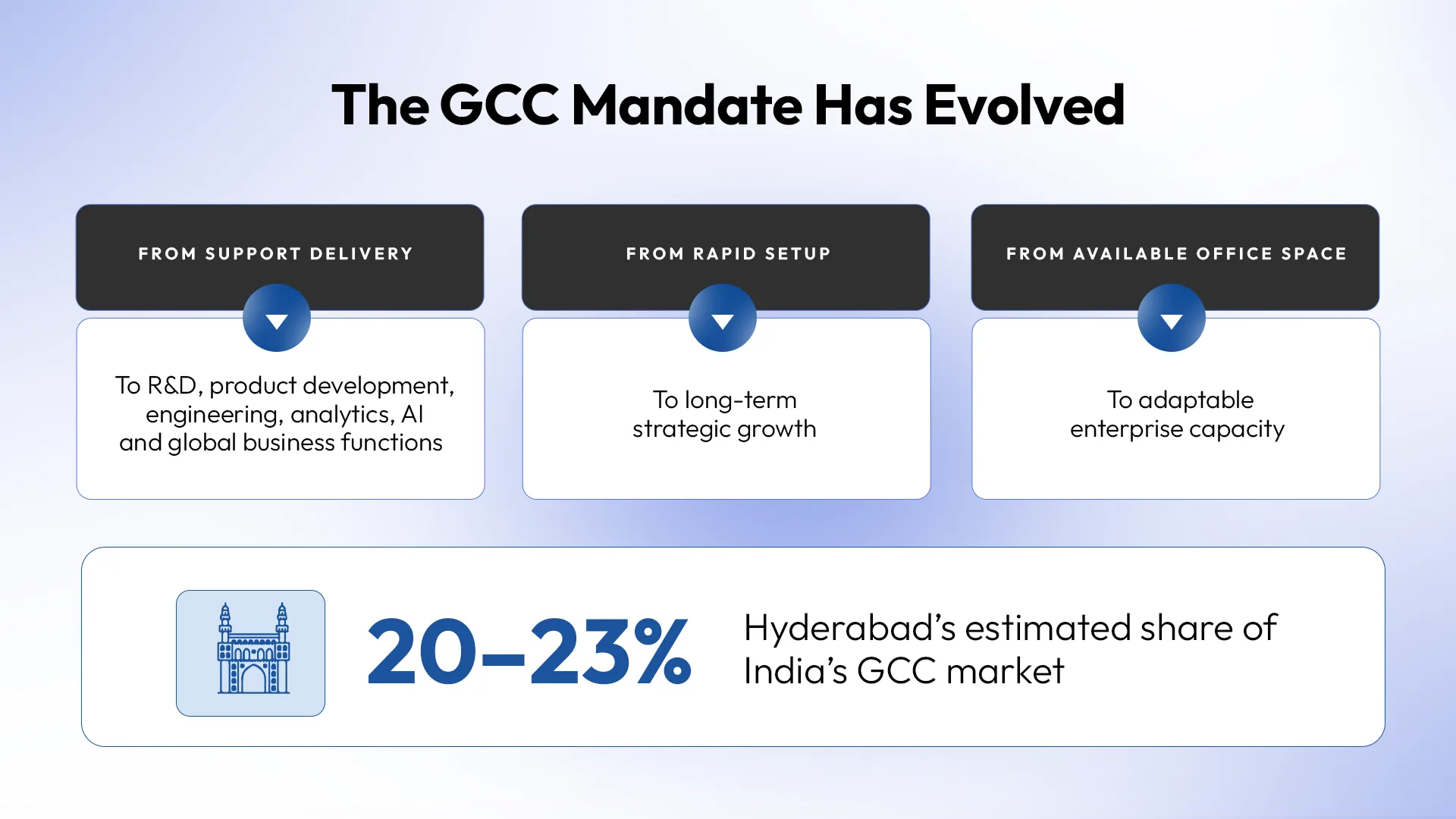
This shift changes the definition of capacity. More inventory is not enough. Enterprises need efficient floor plates, resilient infrastructure, technology and compliance readiness, sustainable building performance and employee environments capable of supporting specialised work.
For enterprises planning their next phase in Hyderabad, location is no longer a near-term real-estate decision. It determines how coherently teams can grow, how quickly new functions can be added and how confidently the organisation can commit for the long term.
“As Hyderabad enters its next phase of GCC growth, the conversation is shifting from how much office stock is available to how good that stock is. Sustainability has moved from a preference to a baseline evaluation criterion for GCCs choosing where to set up. The micromarkets that can offer this at scale with speed or flexibility will lead the city's next wave.”
Harini Adidam, Associate Principal Director | Sales, Hyderabad
Hyderabad’s Workplace Map Is Expanding
HITEC City, Gachibowli and the Financial District remain the centre of Hyderabad’s enterprise ecosystem. Their concentration of talent, businesses and supporting infrastructure will continue to anchor the city’s GCC proposition.
But sustained absorption, limited recent supply and growing demand for Grade A environments are creating requirements that mature districts may not always be able to accommodate alone. Larger enterprises need room to expand without dispersing teams across disconnected locations, compromising infrastructure standards, or relocating every few years.
In line with this shift, the Neopolis micromarket in Kokapet is fast emerging as a destination for large-format commercial development.³ This is not demand moving away from Hyderabad’s established business districts. It is the western enterprise corridor expanding around them.
Neopolis combines the development capacity of a new business district with access to West Hyderabad’s established talent, corporate and residential ecosystem.
Neopolis and Grava Business Park: Enterprise Capacity by Design
Planned across approximately 530 acres, Neopolis is positioned to support large-format commercial development through dedicated infrastructure, wide internal roads and access to the Financial District, Outer Ring Road and airport corridor.⁴
The proposed 11.6-km Metro Phase II corridor from Raidurg to Neopolis could strengthen this integration further, although it remains planned rather than operational.⁵
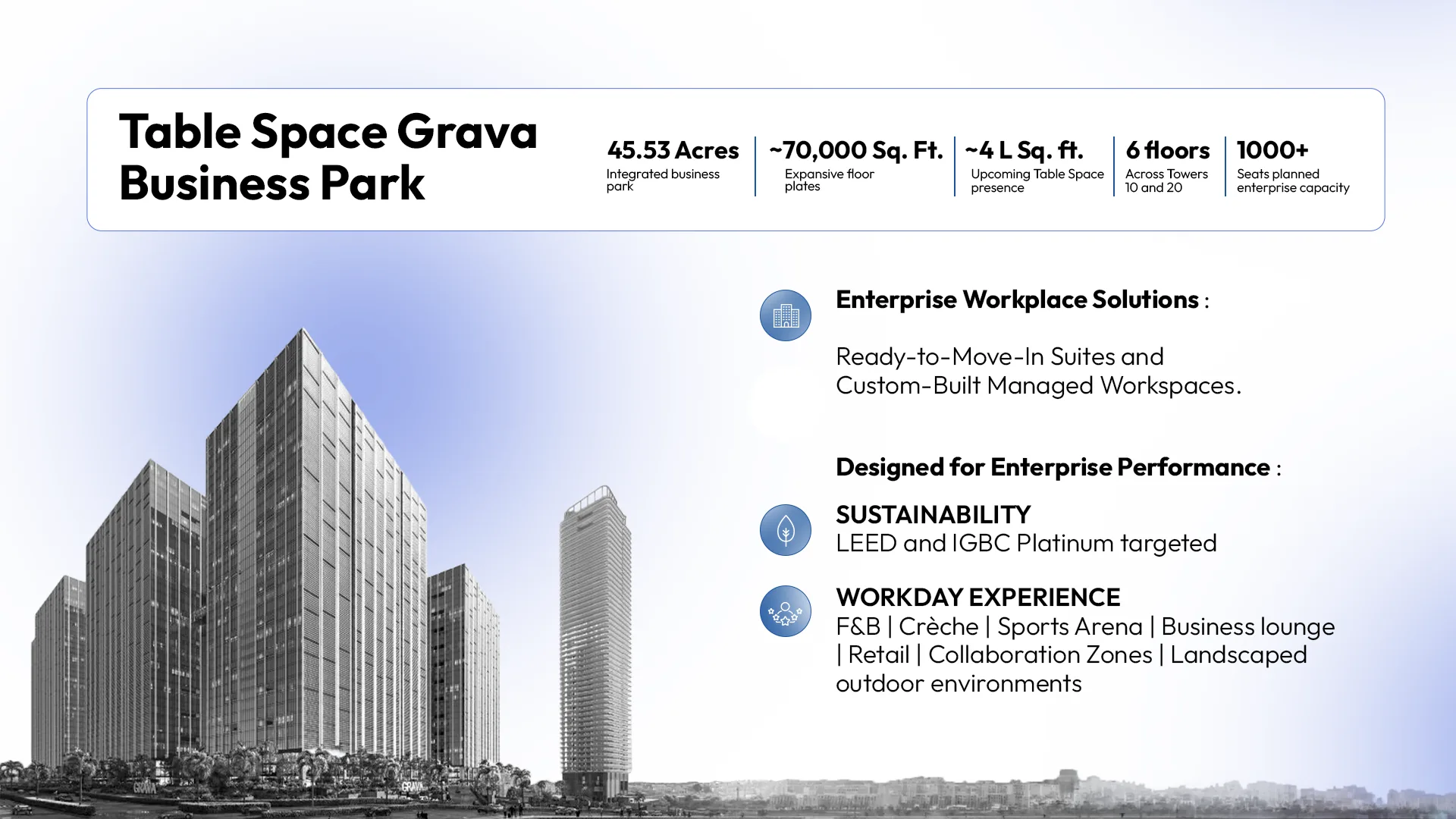
Table Space Grava Business Park’s value lies in how these elements combine into an enterprise operating environment. Expansive floor plates enable consolidation. Resilient building systems protect continuity. Shared amenities and landscaped environments strengthen the workplace’s ability to attract and support talent.
For a GCC planning around a longer and more strategic mandate, these are not separate real-estate considerations. Together, they determine how effectively the workplace can support scale, performance and change.
From Market Insight to Table Space Execution
We see Hyderabad’s next phase of GCC growth being led by enterprises that need scale without fragmentation, customisation without delivery complexity and flexibility without compromising control.
Table Space Grava Business Park is being developed around two enterprise formats: Custom-Built Managed Workspaces for organisations requiring deeply tailored environments, and Ready-to-Move-In Suites for teams seeking enterprise-ready space with greater speed to occupancy. Together, they will give businesses the flexibility to enter, consolidate and scale within the same ecosystem as their teams and mandates evolve.
Through our end-to-end capabilities across leasing, design, build, technology and operations, we will provide a single accountable workplace model aligned to each enterprise’s identity, workflows and operational requirements. Planned meeting and training rooms, collaboration zones, work cafés, hospitality services, and enterprise-grade connectivity will support both immediate readiness and long-term performance.⁶
Table Space Grava Business Park is not a routine addition to our Hyderabad portfolio. It is a deliberate response to where the city’s next generation of enterprise demand is heading.