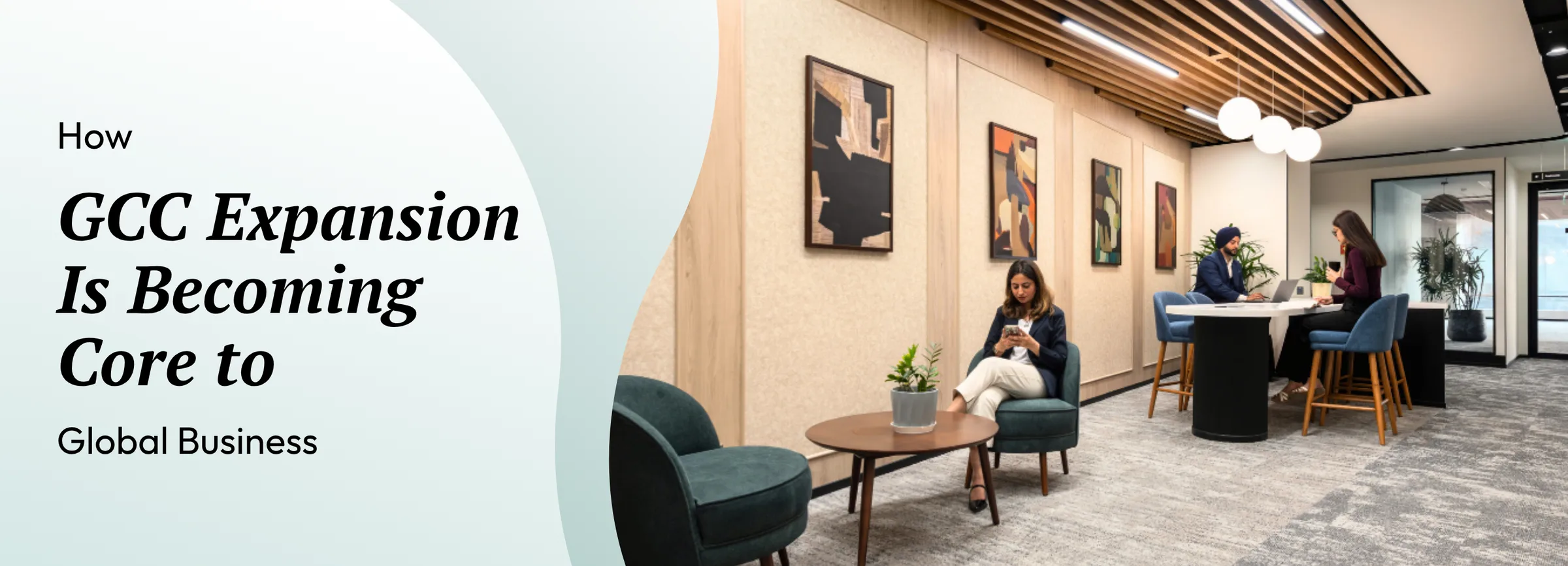
The question global enterprises used to ask about India was where to locate a GCC. The question they ask now is how to build one that behaves like a strategic asset rather than a cost line. For two decades, the GCC conversation in India was framed around cost arbitrage: which city offered the cheapest talent, the lowest rent, the fastest hiring. That framing is now outdated. India has over 3,720 GCC units, the largest share of any country globally, and roughly 60% of Fortune 500 companies now run a GCC here (CBRE Report). Global capability centres headquartered in India are increasingly running product roadmaps, R&D charters, and AI initiatives that used to sit exclusively at headquarters, and the real estate decisions behind them have had to grow up accordingly.
This shift matters because it inverts the order in which enterprises have traditionally made India decisions. City selection used to come first, workplace strategy second. Enterprises that get this sequence wrong end up with a lease signed in the right city but a workplace that cannot support the mandate the centre was set up for. Getting it right starts with treating workplace strategy as the primary decision, and city as one input into it.
GCCs Are Moving From Execution Hubs to Strategic Ownership Centres
The defining trend of the next decade is a change in what GCCs are trusted to do. Centres that once handled back-office processing and IT support now own end-to-end products, platforms, and AI-led mandates for their parent organisations. That shift changes the profile of talent a centre needs to attract, and it changes what its physical workplace has to deliver: fewer transactional desks, more environments built for cross-functional, high-collaboration work.
This has direct consequences for real estate planning. A centre with a strategic mandate cannot be supported by conventional timelines or generic floorplates. It needs space that can scale as fast as the mandate does, and infrastructure that can flex without renegotiating a lease every time the centre's remit expands.
Tier-2 Cities Are Becoming Genuine GCC Corridors, Not Overflow Options
Bengaluru, Hyderabad, and Chennai still account for the bulk of GCC leasing demand, but Tier-2 cities are no longer a fallback for enterprises priced out of the metros. Business-friendly state policies, improving talent pipelines, and urban infrastructure upgrades are turning cities beyond the traditional corridors into primary options rather than secondary ones.
For enterprises, this expands the map of viable locations, but it also raises the bar on due diligence. A Tier-2 micromarket needs to be evaluated on the same dimensions as an established one: talent depth, connectivity, and whether a delivery partner can execute a large floorplate on time in a market they may be entering for the first time.
The Managed Office Model Has Become the Default, Not the Alternative
The flexible and managed workspace category has grown fastest specifically among GCCs, and the reason is structural rather than cyclical. Enterprises running strategic mandates need workspace that moves at the pace of the business, and conventional real estate timelines, long lease negotiations, multi-quarter fit-outs, capital committed before a single employee sits down, do not move at that pace.
Managed offices solve this by compressing the timeline between decision and occupancy while still delivering enterprise-grade design, technology, and compliance readiness. This is why the model has shifted from being positioned as an alternative to conventional leasing toward being the default structure a growing share of Fortune 500 GCC operations in India now choose. Table Space's own client base reflects how far this shift has gone: of its 431 unique clients across 11.46 million sq ft of leasable area, 115 are GCCs, together accounting for 53.50% of its leased area, and its mature facilities run at 92.64% occupancy, the highest among benchmarked operators (CBRE Report, cited in the company's August 2026 DRHP).
Workplace Strategy Now Has to Integrate Five Variables at Once
The enterprises getting this right are not treating location, infrastructure, technology, flexibility, and execution as separate work-streams handled by separate teams. They are planning them together, because a decision in one variable constrains the others: a location choice limits which infrastructure is realistically deliverable on a given timeline, and a technology requirement can rule out certain buildings before location is even discussed.
Speaking to The Economic Times about this shift, Karan Chopra, Chairman & Co-CEO of Table Space, argued that the sector's next phase will be won by providers who can plan across all five variables at once, rather than optimising one and hoping the rest fall into place. His full conversation on how this integrated approach is reshaping enterprise workplace strategy in India is available in the Economic Times feature.
"The opportunity for India isn't just to host more GCCs. It's to help global enterprises build and scale them better, by bringing location, infrastructure, technology, flexibility, and execution together as one decision instead of five separate ones." — Karan Chopra, Chairman & Co-CEO, Table Space
The First 90 Days Determine the Next Five Years
For global heads of real estate and CFOs evaluating India, the decisions made in the earliest phase of a GCC's setup, choice of operating model, city, and delivery partner, set the cost, timeline, and quality trajectory for years afterward. A managed office decision made quickly but without diligence can lock a centre into infrastructure that cannot support the mandate it grows into. A decision made too slowly can mean losing the talent window a city offered in the first place.
This is the practical argument for integrated planning rather than sequential decision-making: enterprises that map location, infrastructure, technology, flexibility, and execution together in the first 90 days spend less time re-negotiating each of those variables individually over the following five years.
India's Opportunity Is Bigger Than Hosting More GCCs
The scale of GCCs already operating in India means the country's role is no longer just about hosting more centres. It is about whether India's workplace ecosystem, providers, city infrastructure, and delivery models, can help enterprises scale the mandates already sitting inside their India centres. That is a different competitive question than the one India answered a decade ago, and it is the one that will define the next one.
Enterprises that recognise workplace strategy as the primary decision, not a downstream consequence of picking a city, will be the ones whose India GCCs move fastest from execution hub to genuine strategic asset.
Comparing operating models for your next GCC in India? Talk to the Table Space team.