
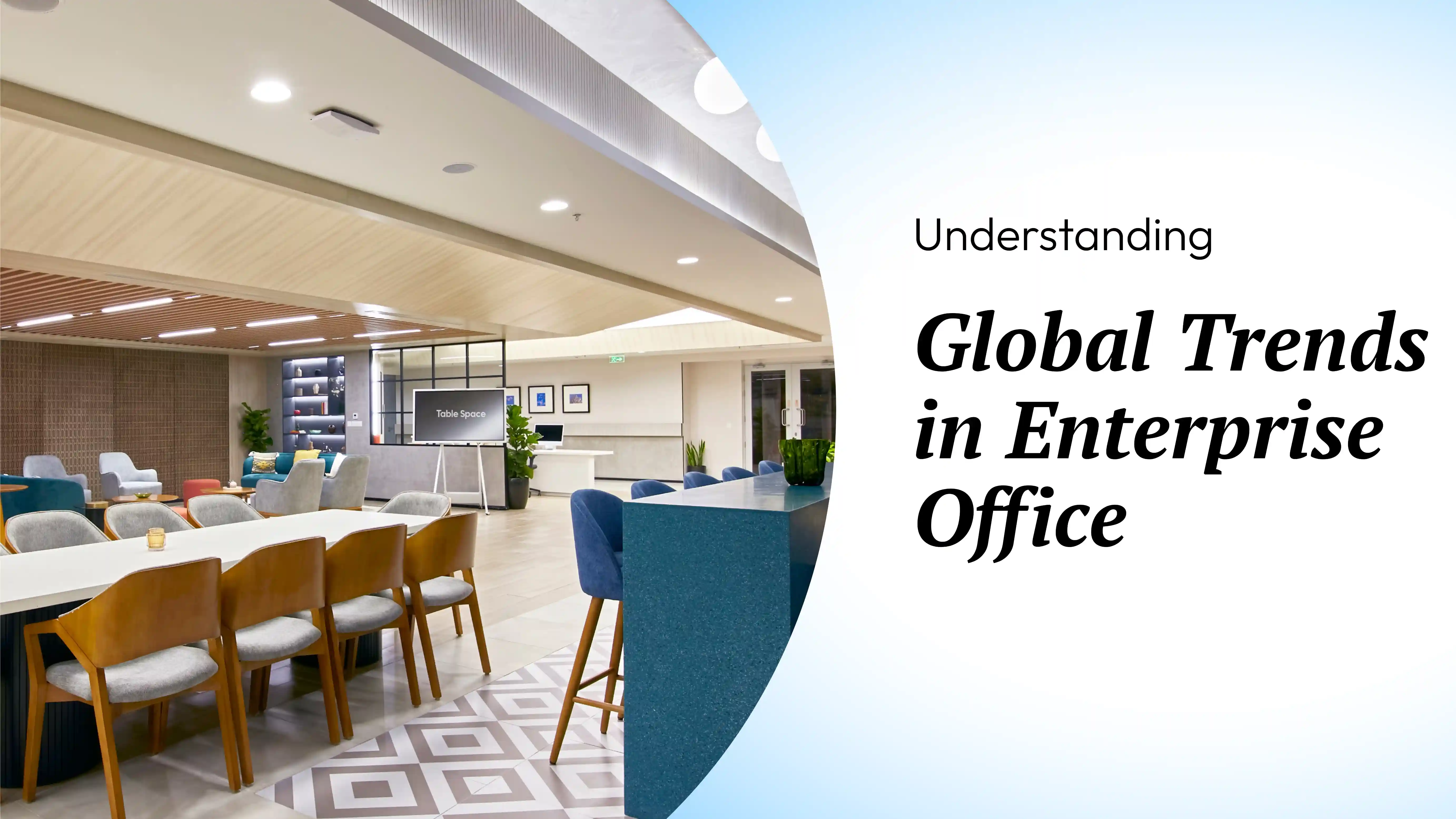
The shift from fixed leases to managed, flexible office portfolios is no longer a post-pandemic adjustment. It is a settled change in how large enterprises think about real estate as an operational input.
The structural change in how large enterprises occupy office space predates the pandemic and has accelerated consistently since it. Fixed, long-term leases that lock capital commitments and headcount assumptions into five to nine year cycles are giving way to managed office portfolios that can flex with the business. This is not a preference shift. It is a rational response to three operating conditions that have become permanent features of the environment: headcount uncertainty, active compliance requirements, and the institutional pressure to deploy capital toward core operations rather than real estate infrastructure.
This piece is for global heads of real estate, CFOs, and operations directors at multinationals who need a clear account of where enterprise office strategy is moving and what the data underlying that movement shows.
The Numbers Behind the Shift
India’s flexible workspace stock has reached 110 to 114 million sq ft, growing at a compound annual rate of 23 to 25% since 2020. Flex penetration has reached 12–16% in leading markets such as Bengaluru and Pune, with the national Grade A average at approximately 8–10% and overall penetration (including B-grade stock) reaching 20%+ in some cities (Knight Frank, 2026).. Globally, 55 to 60% of flex demand now originates from enterprises rather than individuals or small teams. These are indicators of a structural reallocation of corporate real estate strategy at scale. GCCs accounted for 37.7% of office leasing across India’s top seven cities in 2025 – 31 million sq ft, the highest annual volume ever recorded for the segment (JLL, January 2026).
“Flexible workspaces are no longer an adjunct. They have become a central pillar of corporate real estate strategy. Organisations are moving away from static capacity models toward workplaces that operate as strategic, adaptable infrastructure for business continuity and growth.”
Kunal Mehra, President and Co-CEO, Table Space
Trend 1: From Fixed Leases to Flex Portfolios
The conventional five to nine year lease was designed for a world where headcount projections were stable, city presence was intended to be permanent, and the cost of building and operating an office was an acceptable overhead for the enterprise to carry internally. None of those assumptions holds reliably for a large multinational operating across multiple geographies in 2026.
Enterprises are now constructing office portfolios with a managed office anchoring the primary headquarters in each city – where compliance requirements are highest and brand environment must be consistent – and flex office space serving secondary city deployments, project teams, and shorter-tenure operations. Research co-published by Cushman and Wakefield with Table Space in 2024 identified this hybrid approach as the defining behaviour of enterprise flex adoption: control at the core, flexibility at the edges.
The crossover point where a managed office delivers lower total cost of ownership than a conventional lease is typically 40 to 75 seats over 12 months, drawn from Table Space’s cost modelling across its India GCC portfolio. For compliance-driven teams, the crossover arrives earlier – at 20 to 30 seats – because the cost of configuring a conventional lease environment to meet active audit requirements is frequently prohibitive relative to a managed office in which that infrastructure is a standard output.
Trend 2: Compliance as a Workspace Design Requirement
Five years ago, compliance for a multinational’s India office was an IT and legal function applied after the office was built. In 2026, it is a workspace design requirement that determines which models are available to the enterprise in the first place.
Enterprises operating under SOC2, ISO 27001, GDPR, or HIPAA cannot use shared network infrastructure. A shared perimeter covers all tenants in a flex or coworking environment. There is no configuration of such an environment that resolves this constraint for a compliance-driven occupier. A managed office provides a dedicated network perimeter, private server infrastructure, and documented physical access controls configured to one occupier’s requirements from the design stage.
For BFSI firms in Mumbai, pharma GCCs in Hyderabad, and technology enterprises in Bengaluru, this is not a differentiating feature. It is the baseline below which no workspace provider is viable. The enterprises that recognised this earliest have also moved fastest, building compliance requirements into the design brief from the outset rather than retrofitting them at considerable cost after handover.
Trend 3: Capital Efficiency Replacing Capital Commitment
A conventional lease requires a security deposit of six to twelve months’ rent plus fitout capital before the first employee occupies the space. For a GCC entering India, this ties up capital that should deploy toward talent, technology, and core operations during the period when those investments matter most.
Managed office models eliminate fitout capital and reduce the deposit to one to two months. The capital released at setup compounds across a multi-city portfolio. For a multinational running GCC operations across Bengaluru, Delhi, Gurugram, Noida, Pune, Hyderabad, Mumbai, and Chennai simultaneously, the aggregate difference between a conventional lease deposit structure and a managed office model across all eight cities is a balance sheet decision with material consequences, not a real estate preference.
Real estate is increasingly evaluated on return on capital deployed rather than cost per square foot. A managed office operational in 90 days with a one to two month deposit delivers a fundamentally different capital profile than a conventional lease requiring six to twelve months’ deposit and twelve to eighteen months to first occupancy.
“India’s office market is now firmly in an enterprise-led phase, where flexible, fully managed solutions are enabling companies to expand with predictability and resilience – turning real estate into a strategic enabler rather than a constraint.”
Karan Chopra, Chairman and CEO, Table Space
Trend 4: India as the Reference Market for Global Enterprise Flex Strategy
India is the market where the managed office model has been most comprehensively tested at enterprise scale. With more than 1,760 GCCs employing 1.9 million professionals, and projections of 2,500-plus GCCs contributing USD 105 billion to the global economy by 2030, India concentrates more enterprise flex demand in a single geography than any comparable market in the world.
The enterprises that have established India operations under a managed model have consistently achieved faster go-live timelines, lower capital exposure, and more consistent compliance outcomes than those using conventional leasing. That operating evidence is now informing enterprise office strategy in other geographies, as real estate leads carry the India playbook back into their global portfolio reviews.
Table Space sits at the centre of this shift, with more than 11.5 million sq ft across 8 cities – Bengaluru, Delhi, Gurugram, Noida, Pune, Hyderabad, Mumbai, and Chennai – a 45% year-on-year delivery growth rate, and a client roster that spans every sector driving GCC expansion in India.
The enterprises building the most operationally efficient global real estate portfolios in 2026 are those that have decoupled office strategy from the assumption that physical ownership equates to operational control. A properly structured managed office delivers more control over brand environment, compliance configuration, and cost structure than a conventional lease – without requiring the enterprise to build and maintain a real estate management function in every market it operates in.