
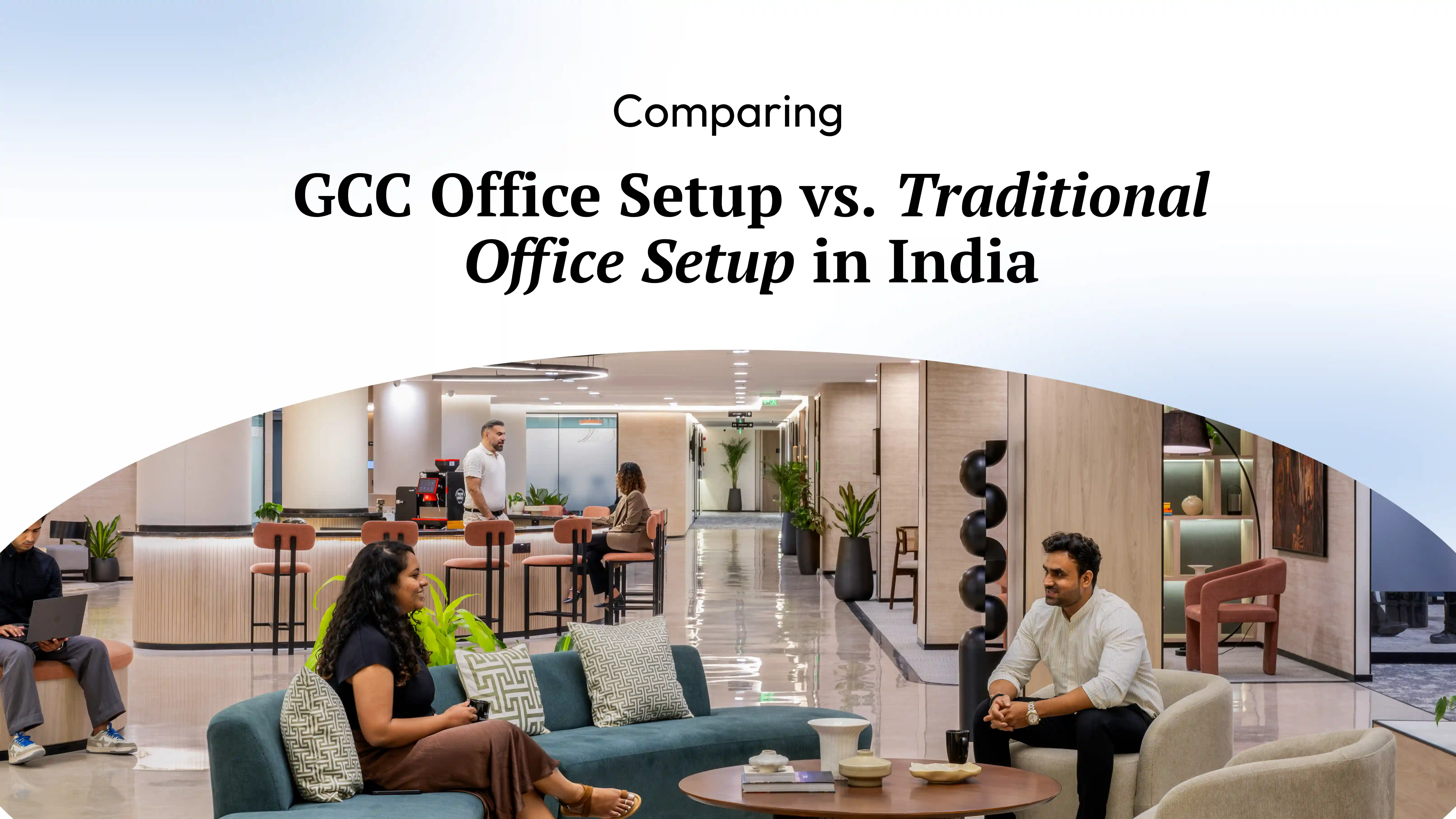
A structural comparison of two fundamentally different approaches to capital commitment, compliance, and operational readiness in the Indian market
GCCs accounted for 38% of office leasing across India’s top seven cities in 2025. The enterprises driving that number are making a foundational choice before a single seat is occupied: a managed office model built around a single provider holding end-to-end accountability, or a traditional setup in which the enterprise directly owns and coordinates every stage of the real estate lifecycle.
The choice has consequences that extend across capital structure, timeline to operational readiness, compliance posture, and the long-term flexibility of the India footprint. For global heads of real estate, GCC directors, and CFOs at multinationals, understanding those consequences in structural terms – rather than through the lens of per-seat cost alone – is the prerequisite for making a decision that serves the organisation’s India mandate over a five to seven year horizon.
What a Traditional Office Setup Actually Demands
The traditional model is built on a single underlying assumption: that the enterprise knows what it needs from an India office for the next five to nine years, has the capital to commit before occupancy, and has or can build the internal capability to run the real estate function independently. For a large, mature organisation with established India operations, that assumption can hold. For most multinationals entering or scaling a GCC in India today, it does not.
Before the first employee is in a seat, a conventional direct-lease setup requires a security deposit of six to twelve months’ rent paid upfront, fitout capital covering design, construction, furniture, and IT infrastructure, a setup timeline of twelve to eighteen months from site selection to first occupancy, and the establishment of ongoing management across seven to ten separate vendor relationships covering construction, facilities, IT, security, and compliance.
The less visible cost is leadership bandwidth. A GCC leadership team in Bengaluru or Hyderabad spending time on vendor disputes, lease administration, compliance retrofitting, and facilities escalations is not spending that time on the engineering, financial services, or technology mandate that justified the India expansion. That opportunity cost does not appear on any balance sheet but compounds materially across the first two to three years of operation.
What a Managed GCC Office Actually Delivers
A managed office for a GCC is a private, fully customised workspace built to the organisation’s specifications and operated end-to-end by a single provider. The GCC controls the floor plan, brand environment, network architecture, and security configuration. The provider holds accountability for delivering and sustaining all of it under one consolidated monthly fee that encompasses rent, fitout amortisation, facilities management, utilities, and security.
|
Variable |
Traditional Setup |
Managed Office Setup |
|---|---|---|
|
Timeline to occupancy |
12 to 18 months |
Approximately 90 days |
|
Security deposit |
6 to 12 months’ rent |
1 to 2 months |
|
Fitout capital |
Upfront by occupier |
Amortised into monthly fee |
|
Vendor relationships |
7 to 10 separate contracts |
1 |
|
Agreement term |
5 to 9 years |
1 to 3 years |
|
Compliance setup |
Arranged independently |
Built in as standard output |
|
Internal RE function |
Required |
Not required |
|
Flexibility to scale |
Renegotiate or sub-let |
Scale up, down, or relocate |
|
Cost visibility |
Year one |
Up to 10 years |
The 90-day delivery standard is a documented outcome. Table Space has brought GCC workspaces online for global clients across sectors at this pace – including an 8,000-seat expansion across three cities completed in under 10 months. Across Bengaluru, Delhi, Gurugram, Noida, Pune, Hyderabad, Mumbai, and Chennai, this model has been tested and delivered at every scale of GCC operation.
“GCCs increasingly prioritise enterprise-grade, managed office solutions that go beyond infrastructure to integrate technology, security, sustainability, and workplace experience at scale. A key requirement emerging across markets is the need for flexibility and rapid scalability, enabling enterprises to expand or recalibrate footprints in line with global business cycles.”
Kunal Mehra, President and Co-CEO, Table Space
For enterprises assessing India before committing to a full fitout programme, or standing up an initial team on an accelerated timeline, Table Space’s ready-to-move-in suites provide an additional entry point. Enterprise-configured from day one – with dedicated network infrastructure, physical access controls, and privacy standards already operational – suites allow a GCC to be occupying compliant, private space within days of decision. As headcount grows and the mandate is confirmed, the same provider relationship extends into a fully bespoke, built-to-brief workspace under one continuing agreement.
The Capital and Compliance Difference
For a GCC entering India, capital allocation in the first twelve months is a strategic decision with consequences that extend across talent, technology, and operational infrastructure. A traditional lease absorbs that capital in deposit and fitout before the operation generates a single output. For a 100-seat team in a Grade A Bengaluru building, the managed model eliminates fitout capital entirely, reduces the security deposit from six to twelve months to one to two months, and removes the need for an internal real estate function. The capital released by that difference belongs in the business.
On compliance, the difference is architectural rather than configurational. A GCC operating under SOC2, ISO 27001, GDPR, or HIPAA requires a dedicated network perimeter, private server infrastructure, and documented physical access controls. Under a managed office model, these are standard outputs of the design and build process. Under a conventional lease, they are self-arranged post-handover – a more expensive, slower, and frequently inadequate approach for enterprises whose compliance requirements are active from day one of occupancy.
For GCCs in BFSI, pharma, and technology, where compliance is a board-level requirement rather than an operational consideration, this distinction determines whether the workspace is viable, not merely whether it is efficient.
Which Model Fits Which GCC
The traditional setup remains the appropriate structure for large, stable operations with an established India real estate function, where GCC headcount is predictable above 500 seats on a five to seven year horizon and full physical ownership of the workspace is a board-level preference.
The managed office is the structurally appropriate default for GCCs entering India for the first time, scaling from an existing India base without building a dedicated real estate function, operating under active compliance requirements that demand dedicated infrastructure from day one, or running headcount projections likely to shift materially within the first 12 to 24 months of setup. The capital saved on deposit and fitout, the compression from 18 months to 90 days, and the elimination of internal real estate overhead represent a cumulative operational advantage at exactly the point when the organisation needs to move with speed and precision.
Conclusion
The comparison between GCC office setup models is, at its core, a question of where capital is committed and who carries operational risk. A traditional lease concentrates both within the enterprise. A managed office transfers operational risk to a provider built to carry it, and redirects capital toward the mandate the India operation was established to fulfil. For most GCCs at the setup or early scaling stage, that distinction is not marginal. It is the difference between a real estate programme and a business programme.
Frequently Asked Questions
How long does a GCC office setup take under a managed model versus a traditional lease?
Under a managed model, approximately 90 days from letter of intent to operational handover. A traditional lease and fitout sequence typically runs 12 to 18 months from site selection to first occupancy.
What are the main capital differences between the two models?
A traditional lease requires six to twelve months’ rent in deposit plus upfront fitout capital before the office is operational. A managed office reduces the deposit to one to two months and eliminates fitout capital entirely, with all costs folded into a single monthly fee.
Do GCCs lose control of their workspace under a managed model?
No. The occupier specifies and controls the floor plan, brand environment, network architecture, and security configuration. The provider manages operational delivery. Control of the workspace and accountability for its operation are structurally separate.
What compliance standards can a managed office meet for a GCC in India?
Dedicated network perimeters, private server infrastructure, and documented physical access controls as standard outputs. LEED, WELL, ISO 9001, 14001, 27001, and 45001. The minimum requirements for SOC2, GDPR, and HIPAA compliance from day one of occupancy, without post-handover retrofit.
When is the traditional setup the more appropriate choice?
When the organisation already has an established India real estate function, when GCC headcount is stable and predictable above 500 seats on a long-term horizon, and when the board’s preference is full physical and operational ownership of the workspace from the outset.