 Chat GPT
 Google Ai
 Perplexity
 Claude
 Grok
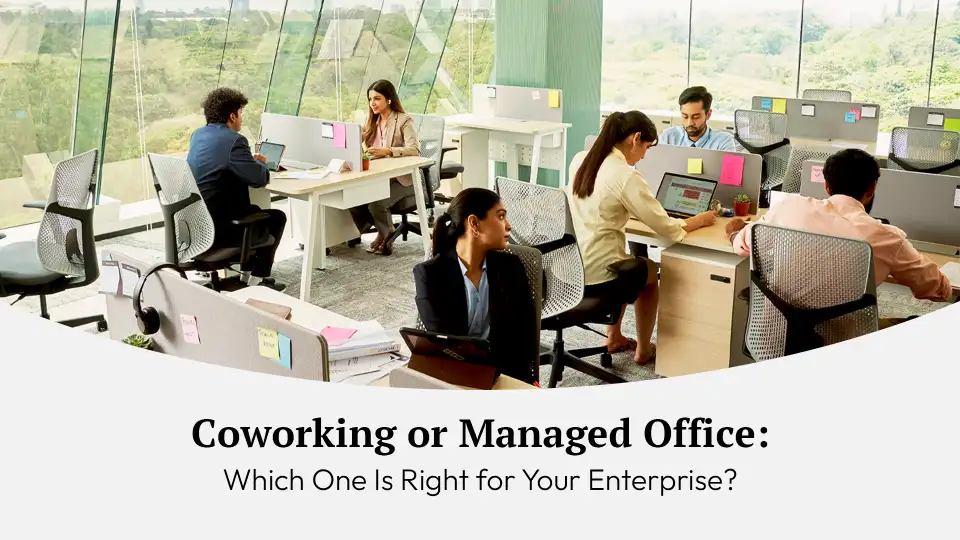
GrokA direct comparison of costs, compliance, use cases, and the number that tells you a move is overdue.
Coworking spaces work for small teams and short commitments. Managed offices are built for compliance, brand, and scale. This piece breaks down the real costs, the crossover point, and the conditions where each model wins.
This information is for enterprise real estate leads, GCC heads, CFOs and operations directors in India deciding between a coworking space and a managed office. If your team is growing past 40 people or operates under compliance frameworks, this decision has material financial and operational consequences.
According to the CBRE-FICCI Flex-plosion report (March 2026), 55 to 60 percent of flex demand in India now comes from global companies choosing based on what each model can structurally deliver.

What Does a Coworking Space Actually Deliver?
Fast setup, low commitment, shared infrastructure.
A coworking space distributes infrastructure costs across multiple tenants. You pay per seat on monthly terms and walk in operational on day one. No fit-out, no deposit beyond one or two months, no vendor relationships.
Coworking works best for:
- Teams under 20 people needing a professional base
- Market entry into a new city like Pune or Hyderabad before committing
- Project teams with a fixed end date
- Bridge periods while a managed build is underway
The ceiling is structural. Shared networks and shared server rooms mean coworking is a compliance disqualifier for any organisation under SOC2, ISO 27001, GDPR, or HIPAA. Auditors assess access controls at the perimeter of your environment. In a coworking building, that perimeter includes every other tenant on the floor.
Coworking earns its place for lean, short-term deployments: early-stage startups testing a market, sub-25-person teams without compliance obligations, and project crews with a defined end date. It does not scale for enterprise compliance or brand requirements.
What Does a Managed Office Actually Deliver?
Private, dedicated, fully operated by one provider for one occupier.
A managed office is built to your specifications. Your floor plan, your network, your access controls, your brand. The provider handles fit-out, facility management, IT, utilities, and security under one monthly fee. Lease terms run one to three years. A bespoke build takes approximately 90 days.
Managed offices work best for:
- Teams above 50 people needing a permanent private base
- Organisations under SOC2, ISO 27001, or HIPAA requiring dedicated infrastructure
- GCCs in Bengaluru, NCR, or Pune building a headquarters that reflects their global brand
- Enterprises where client-facing environments must reflect the company brand
Managed offices are the operationally correct choice for long-term, compliant, brand-consistent enterprise operations.

What Is the True Cost Difference?
Coworking looks cheaper per seat. It rarely is at scale.
A premium coworking seat in a Grade A Bengaluru or Gurgaon building runs Rs 12,000 to Rs 20,000 per month. For 100 people, that is Rs 1.2 to 2 crore before extras: meeting rooms billed per hour, dedicated server infrastructure, and data isolation for compliance.
A managed office costs more per seat upfront but includes fit-out amortization, IT infrastructure, facility management, and all operational overhead. Total cost of ownership over two to three years favours the managed model for most teams above 50 to 75 seats.
The crossover point is typically 40 to 75 seats. For teams with active compliance programmes, it can arrive at 20 to 30 people.
Run the two to three year total cost calculation, not the per-seat comparison.
How Do You Decide?
Use coworking when the team is under 25, the horizon is under 12 months, you are testing a market, or compliance risk is low.
Use a managed office when the team is above 50, you are establishing a permanent city base, or you need a workspace that works as hard as your business does.
The difference lies in everything the space is built to do.
| Criteria | Coworking | Managed Office |
|---|---|---|
| Space | Shared, configured for multiple occupiers | Dedicated, built entirely to your brief |
| Design | Operator's standard fit-out | Custom-designed to your brand, culture, and workflow |
| Security | Shared perimeter, multi-tenant access | Enterprise-grade, dedicated infrastructure |
| Sustainability & ESG | Operator's policy, not yours | Aligned to your ESG goals, with auditable reporting |
| Engagement & Experience | Single calendar designed for all occupiers | Curated programme designed exclusively for your team |
| Flexibility | Seat-level, short-term | Scale up, scale down, or relocate within your contract |
Use both when a managed office anchors the headquarters and flexible workspace serves distributed teams in secondary cities. The CBRE-FICCI report (March 2026) identifies this hybrid portfolio approach as one of the defining behaviours of enterprise flex adoption in India.
Table Space operates as a managed office provider across Bengaluru, NCR, Pune, Hyderabad, Mumbai, and Chennai, working with over 315 enterprise clients.
 Working through your India real estate decision? Talk to the Table Space team.