
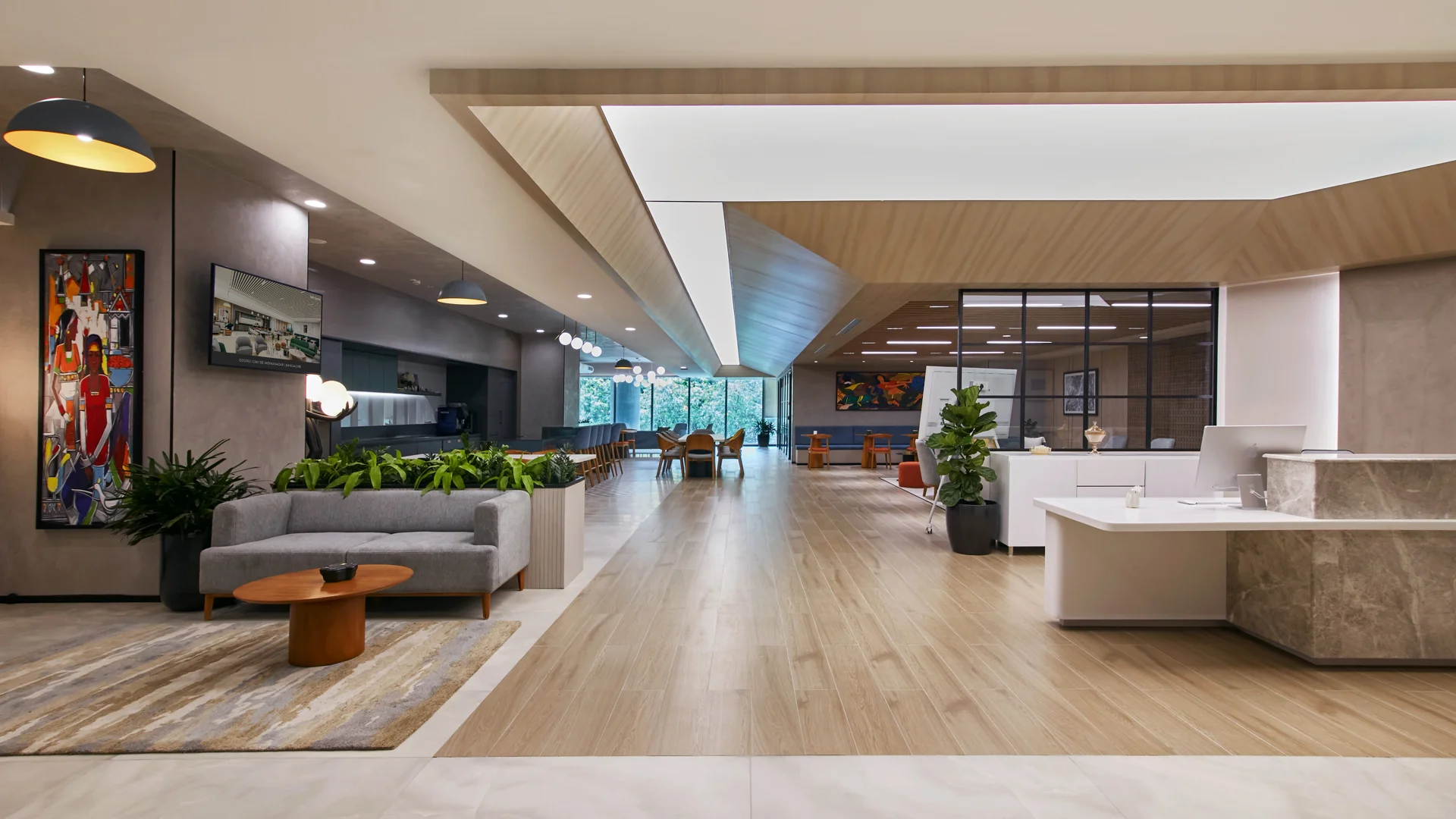
Why Speed, Efficiency, and Scale Define Table Space
Consolidating multiple corporate office spaces into one headquarters is a complex enterprise decision. It requires coordination across real estate, design, infrastructure, workplace operations, and employee experience, while keeping business continuity intact.
This case study shows how Table Space helped a global enterprise consolidate three offices into a single, centralised headquarters in under 100 days.
The outcome was measured across speed, efficiency, and workplace performance: a 1,200-seat headquarters delivered in 93 days, 37% reduction in operational costs over five years, 28% improvement in workspace utilisation, and 90% employee satisfaction. For enterprises evaluating managed office cost savings in India, this case shows how consolidation, faster execution, and operational efficiency can create measurable business impact.
For enterprises planning large-scale workspace consolidation, the lesson is clear. With the right managed office partner, office transformation can move faster, operate with greater cost clarity, and support teams without disrupting business momentum. This detailed guide on managed workspaces and operational cost savings explains how enterprises are improving efficiency while reducing operational complexity through managed workspace models.”
Operational Summary: Table Space Case Study
This Table Space case study highlights the consolidation of three separate offices into one centralised headquarters in Bengaluru. The project was delivered as a 1,200+ seat managed enterprise suite within 93 days, supporting the client’s need for speed, scale, and business continuity. Through a structured managed workspace model, the consolidation achieved 37% cost savings over five years and enabled deployment 41% faster than a conventional office setup.
The project reflects how Table Space helps enterprises bring multiple teams into one efficient, operationally ready workspace without compromising control, employee experience, or long-term scalability.
Why is Multi-Office Consolidation So Challenging?
While consolidation may seem like a straightforward decision, it impacts multiple layers of the business, from people and processes to infrastructure, commercial office spaces, and timelines.
Key Challenges
- Long setup timelines (typically 3–6 months)
- High upfront capex
- Fragmented teams across multiple locations and new hires
- Talent attraction and retention concerns
- Complex vendor negotiations and coordination
- Delays in asset procurement and setup
- Underutilized or inefficient workspace design
Traditional office models are not designed for this level of speed and flexibility, especially with consolidation.
How do Enterprises Approach HQ Consolidation?
When planning a headquarters consolidation, most enterprises consider one of three models:
| Model | Timeline | Cost | Flexibility | Risk |
| Traditional Lease | High | High | Low | High |
| Coworking | Medium | Medium | Medium | Medium |
| Managed Enterprise Suites | Low | Optimized | High | Low |
While traditional leases offer control, they come with long timelines and high upfront capital investment. Coworking offices provide flexibility but often lack customization.
Managed enterprise suites offer middle ground, combining speed, flexibility, and scalability.
The Business Need
In this case, the enterprise was experiencing rapid growth across three separate office locations. While expansion was a positive sign, it was also leading to operational inefficiencies, higher costs, and fragmented teams.
Collaboration was becoming harder, and managing multiple offices was slowing down decision-making. Leadership needed a way to unify teams into a single, scalable environment, without disrupting ongoing operations or slowing down the hiring process.
The challenge wasn’t just consolidation. It was doing it quickly, efficiently, and without compromise.
How the HQ Was Built in 93 Days
Instead of following the traditional route, the company adopted a managed approach to streamline execution.
Step 1: Requirement Mapping
The process began with defining:
- Total seat requirements (1,200+)
- Team-wise space allocation
- Future scalability needs
This ensured the workspace was not just built for today, but ready for the future.
Step 2: Location Strategy
Choosing the right location was critical.
The focus was on:
- Accessibility for employees
- Centralized positioning
A well-planned location helped improve both employee experience and operational efficiency.
Step 3: Custom Build & Execution
The corporate workspace was designed and delivered end-to-end:
- Fully customized layouts
- Infrastructure setup
- Vendor coordination
- Plug-and-play readiness
All within a compressed timeline of just 93 days.
Visualizing the Transformation
To better understand the impact, here’s what changed:
| Before | After |
|
|
|
|
|
|
The Business Impact We Created
The impact of this consolidation extended beyond operational efficiency, it delivered measurable improvements across cost, speed, and employee experience.
- 37% cost reduction over 5 years
Lower capital expenditure and optimized operational costs
- 28% improvement in space utilization
Smarter design and efficient allocation
- 41% faster deployment
Compared to traditional office setup timelines
- 90% employee satisfaction
Better infrastructure, accessibility, and workplace experience
What Enterprises Can Learn from this?
This case highlights a broader shift in how organizations approach workplace strategy:
- Consolidation can be a strategic advantage, not just an operational move
- Speed is now a competitive differentiator
- Flexibility reduces long-term risk
- Managed models improve cost, utilization, and employee experience
As enterprises continue to scale, the way they approach workplace infrastructure is evolving. Speed, flexibility, and efficiency are no longer optional,they are essential.
This case demonstrates that with the right approach, even complex transformations like headquarters consolidation can be executed faster and more effectively than traditional models allow.
FAQs
- What is office consolidation in enterprises?
Office consolidation is the process of merging multiple office locations into a single centralized headquarters. It helps enterprises improve operational efficiency, reduce costs, and bring teams together for better collaboration.
- How long does it take to build an enterprise headquarters?
Traditionally, setting up an enterprise HQ can take 3 to 6 months or longer. However, managed office solutions can significantly reduce this timeline, enabling companies to move into fully operational workspaces in under 100 days.
- Why do companies consolidate multiple offices into one HQ?
Companies consolidate offices to:
- Reduce operational costs
- Improve collaboration
- Centralize teams and decision-making
- Enhance employee experience
- Optimize workspace utilization
- What are the biggest challenges in office consolidation?
Key challenges include:
- Long setup timelines
- High upfront capital expenditure
- Vendor coordination complexity
- Managing employee transition
- Maintaining business continuity
- Can large enterprises scale quickly with managed office solutions?
Yes, managed office solutions are designed for scalability. Enterprises can expand or customize office space based on growth without the delays and risks associated with traditional leasing models.
- How does workspace design impact employee productivity?
A well-designed workspace improves collaboration, comfort, and efficiency. Features like collaborative zones, ergonomic layouts, and reliable infrastructure directly contribute to higher productivity and employee satisfaction.