
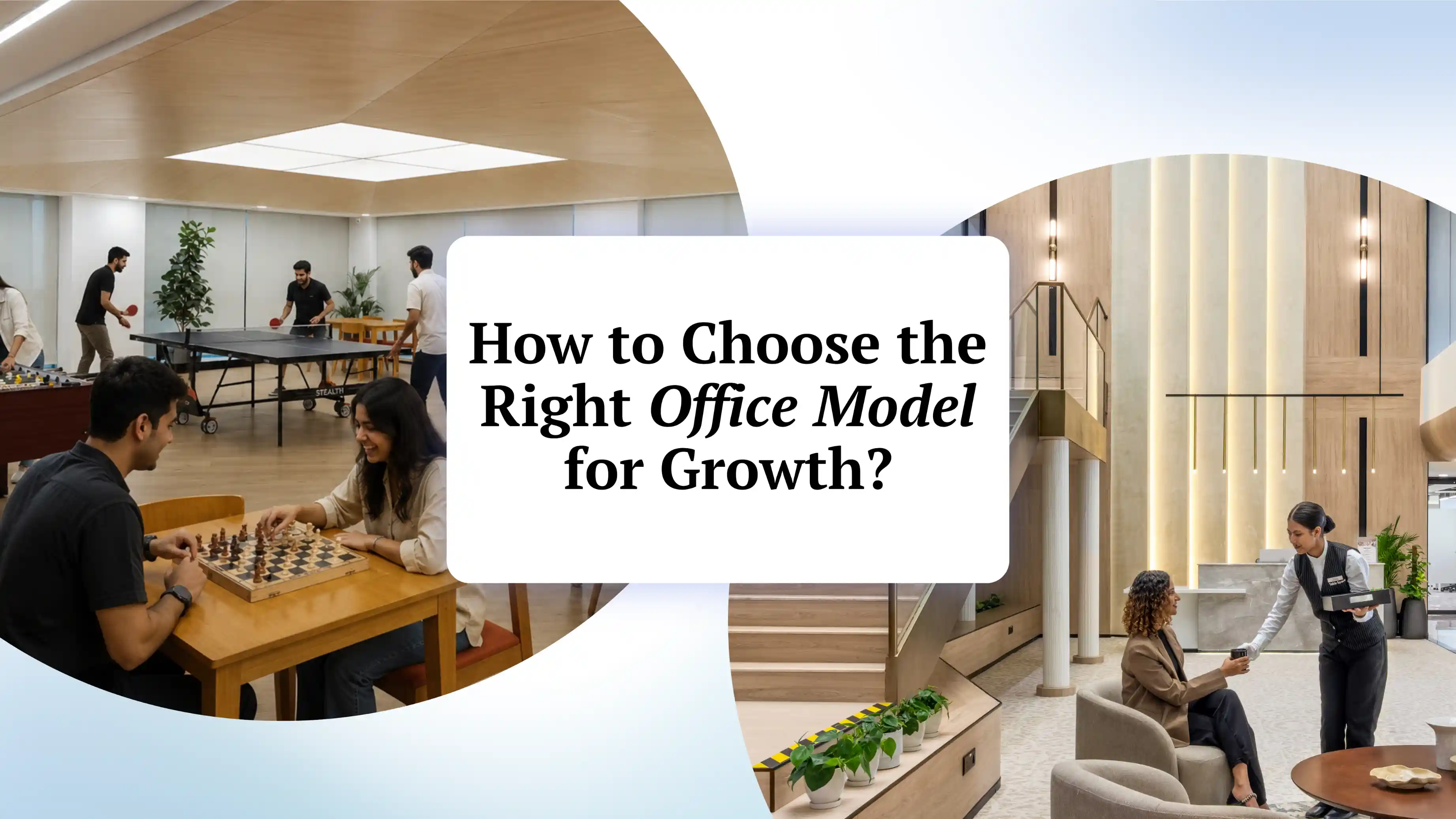
The decision is not which workspace looks best on a site visit. It is which model keeps pace with the business as it actually grows.
Enterprises evaluating office space in India face a version of the same question in every city: which model fits the operation we are building, not the operation we had when we signed the last lease. The answer requires a framework that accounts for capital structure, compliance posture, headcount flexibility, and timeline to operational readiness, applied in that order, before any shortlist is compiled.
The workspace decision gets made badly when cost per seat is the opening comparison. Cost per seat is a function of what is being purchased, and across the 3 primary models available in India, what is being purchased is structurally different. Comparing them on a single number is like comparing a conventional lease, a managed office, and a coworking arrangement on monthly rent and concluding they are the same product at different prices.
This framework is for VP Real Estate, CFOs, and operations directors at enterprises evaluating workspace models in India, including those managing multi-city GCC portfolios, first-time India entrants, and organisations scaling from an established base.
“Cost per seat is the number everyone compares and the one that tells you the least. Total cost of ownership over 36 months, with deposit, fitout capital, and vendor overhead included, is where the real difference shows. Above 50 seats, the managed model wins that comparison consistently.”
Bittu Varghese, Chief Financial Officer
Step 1: Define the Compliance Brief Before Anything Else
The compliance brief is a binary filter. Enterprises operating under SOC2, ISO 27001, GDPR, or HIPAA require a dedicated network perimeter, private server infrastructure, and documented physical access controls. A coworking environment cannot provide these. A shared network perimeter covers all tenants. There is no configuration that resolves this for a compliance-driven occupier.
A managed office delivers dedicated compliance infrastructure as a standard output of the design and build process, not a post-handover retrofit. Table Space builds to SOC2, ISO 27001, GDPR, and HIPAA requirements as baseline delivery standards across its 80+ centres in 8 cities. For BFSI firms in Mumbai, pharma GCCs in Hyderabad, and technology enterprises in Bengaluru, this is not a differentiating feature. It is the baseline below which no provider is viable.
Apply the compliance filter before comparing anything else. Any provider that cannot demonstrate dedicated network perimeters, private server infrastructure, and documented physical access controls as standard outputs of the build is not on the shortlist for a compliance-driven brief, regardless of price.
Step 2: Establish the Capital Structure
The capital question has 2 parts: how much is committed before the first employee occupies the space, and what happens to that capital if the headcount assumption turns out to be wrong within 24 months.
A conventional direct lease requires a security deposit of 6 to 12 months’ rent plus fitout capital before occupancy. For a 300-seat team in a Grade A Bengaluru building, that is a material capital commitment deployed before the operation generates a single rupee of output. Under a managed office model, the deposit drops to 1 to 2 months. Fitout capital is eliminated entirely, folded into a single monthly operating fee. The capital released by that difference belongs in the business, in talent, technology, and the mandate the India operation was established to fulfil.
Table Space’s cost modelling across its India GCC portfolio shows the managed model delivers lower total cost of ownership than a conventional lease above 50 seats over a 24 to 36 month horizon, when deposit, fitout capital, IT infrastructure, internal real estate headcount, and vendor management overhead are included in the comparison. The per-seat monthly rate is the wrong starting point. Total cost of ownership over 24 to 36 months is the right one.
Step 3: Map the Headcount Trajectory
A workspace model signed to a fixed headcount assumption that turns out to be wrong within 18 months is a liability, not an asset. For enterprises scaling a GCC, the headcount trajectory in years 1 and 2 is rarely the headcount trajectory that was projected at the point of signing.
A conventional lease locks in a headcount assumption for 5 to 9 years. Scaling up requires renegotiation. Scaling down requires sub-letting or carrying unexpired rent. A managed office contract, structured correctly, allows the enterprise to scale seats up, scale down, or relocate to another city within the existing provider relationship, without triggering a fresh procurement cycle or unexpired rent liability.
Table Space structures managed office contracts to accommodate the organisation’s actual growth trajectory rather than a fixed headcount assumption. Across 425+ enterprise clients, 1 in every 3 is a GCC. The 45% repeat engagement rate is the operating evidence of what flexible, growth-aligned contract structures produce when enterprises are given the option to stay rather than leave.
Step 4: Establish the Timeline Requirement
The timeline to operational readiness determines which models are available. A conventional lease and fitout sequence runs 12 to 18 months from site selection to first occupancy. A managed office is operational in approximately 90 days. For enterprises working to a board-approved GCC launch timeline, or responding to a talent acquisition window, the 12 to 18 month conventional model is frequently not an available option.
Table Space’s 90-day delivery standard is a documented outcome, not a marketing claim. It is a function of parallel workstreams under one accountable provider, a pre-qualified supplier network of 1,250+ suppliers with forward rate contracts on standard materials, and 2 to 3 million sq ft of annual delivery that has absorbed the learning curve a single-project enterprise would otherwise spend its first year navigating.
For enterprises that need space on an accelerated timeline before a full managed build-out is ready, Table Space’s Ready-to-move-in Suites deliver enterprise-configured, compliance-ready occupancy within 24 hours of decision. Dedicated network infrastructure, physical access controls, and privacy standards operational from day one, under the same provider relationship that extends into a fully bespoke workspace as the mandate is confirmed.
Step 5: Assess Provider Accountability
The accountability question is simple in principle and often obscured in practice. Which stages of the real estate lifecycle does the provider own directly, and which do they subcontract? Site identification, lease negotiation, design, construction, IT infrastructure, and post-handover operations are the 6 stages. A provider who owns all 6 has one point of accountability. A provider who subcontracts 2 or 3 of those stages is a coordinator. The enterprise assumes the risk of every transition between parties.
Table Space owns all 6 stages in-house across its full India network. Lease, design, construction, IT infrastructure, and post-handover operations sit under one agreement across 8 cities and 80+ centres. That accountability structure is verifiable across a portfolio of 425+ enterprise clients spanning BFSI, technology, engineering, and professional services. The repeat engagement rate of 45% is the most reliable external measure of what genuine single-point accountability produces when tested at scale.
The Decision Framework Applied
|
Criterion |
Question to ask |
What the answer determines |
|
Compliance |
Does the brief require dedicated network perimeters and private server infrastructure? |
Coworking is eliminated for compliance-driven enterprises. Managed office is the minimum viable model. |
|
Capital |
How much capital is committed before occupancy, and what is the 24-month total cost of ownership? |
Managed office consistently delivers lower total cost above 50 seats over 24 to 36 months. |
|
Headcount |
How likely is the headcount assumption to shift within 18 to 24 months? |
Fixed leases carry renegotiation risk for scaling GCCs. Managed contracts accommodate growth within the existing agreement. |
|
Timeline |
What is the operational readiness deadline? |
Conventional leases require 12 to 18 months. Managed offices deliver in approximately 90 days. Ready-to-move-in Suites deliver in 24 hours. |
|
Accountability |
How many stages of the real estate lifecycle does the provider own directly? |
6 of 6 in-house means one point of accountability. Anything less distributes risk back to the enterprise. |
Applying the Framework to Table Space
Table Space operates across 8 cities, Bengaluru, Delhi, Gurugram, Noida, Pune, Hyderabad, Mumbai, and Chennai, with 80+ centres and 11.5 million sq ft under management. The portfolio spans Custom-Built Managed Workspaces, Ready-to-move-in Suites, DESYN design and build, and Global Connect GCC enablement. Across every product, all 6 stages of the real estate lifecycle sit under one agreement and one point of accountability.
For enterprises applying the framework above, that accountability structure answers the fifth criterion outright. The compliance infrastructure, delivery timeline, capital structure, and headcount flexibility are then verified against the documented delivery record: 3.2 million sq ft delivered in FY 2025-26, 125+ enterprise projects, 20+ projects of 50,000 sq ft and above, and occupancy above 90% on a leasable area of approximately 10.2 million sq ft as of 31st March 2026.
The workspace decision is a business decision with real estate consequences. The framework above is the order in which those consequences are best understood.
Frequently Asked Questions
What is the single most important factor when choosing an enterprise workspace in India?
Scope of accountability. The question is not what services a provider lists, but which of those services they own directly. A provider holding all 6 stages of the real estate lifecycle in-house, from lease through post-handover operations, carries undivided accountability for the outcome. Anything less transfers coordination risk back to the enterprise.
How should enterprises compare the cost of different workspace models?
Total cost of ownership over 24 to 36 months, incorporating security deposit, fitout capital, IT infrastructure, facilities management, internal real estate headcount, and vendor management overhead. The managed model consistently delivers lower total cost above 50 seats over that horizon when the full cost picture is included.
At what seat count does a managed office become more cost-effective than a conventional lease?
Above 50 seats over a 12-month horizon when total cost of ownership is compared. For compliance-driven teams, the crossover arrives earlier, at 20 to 30 seats, because the cost of configuring a conventional lease environment to meet active audit requirements is included in the comparison.
How quickly can Table Space deliver a compliant, enterprise-grade workspace in India?
Approximately 90 days from letter of intent to operational handover for a mid-sized requirement. Deployments above 100,000 sq ft run 120 to 150 days. Ready-to-move-in Suites are available within 24 hours of decision, enterprise-configured with dedicated network infrastructure and compliance standards operational from day one.