
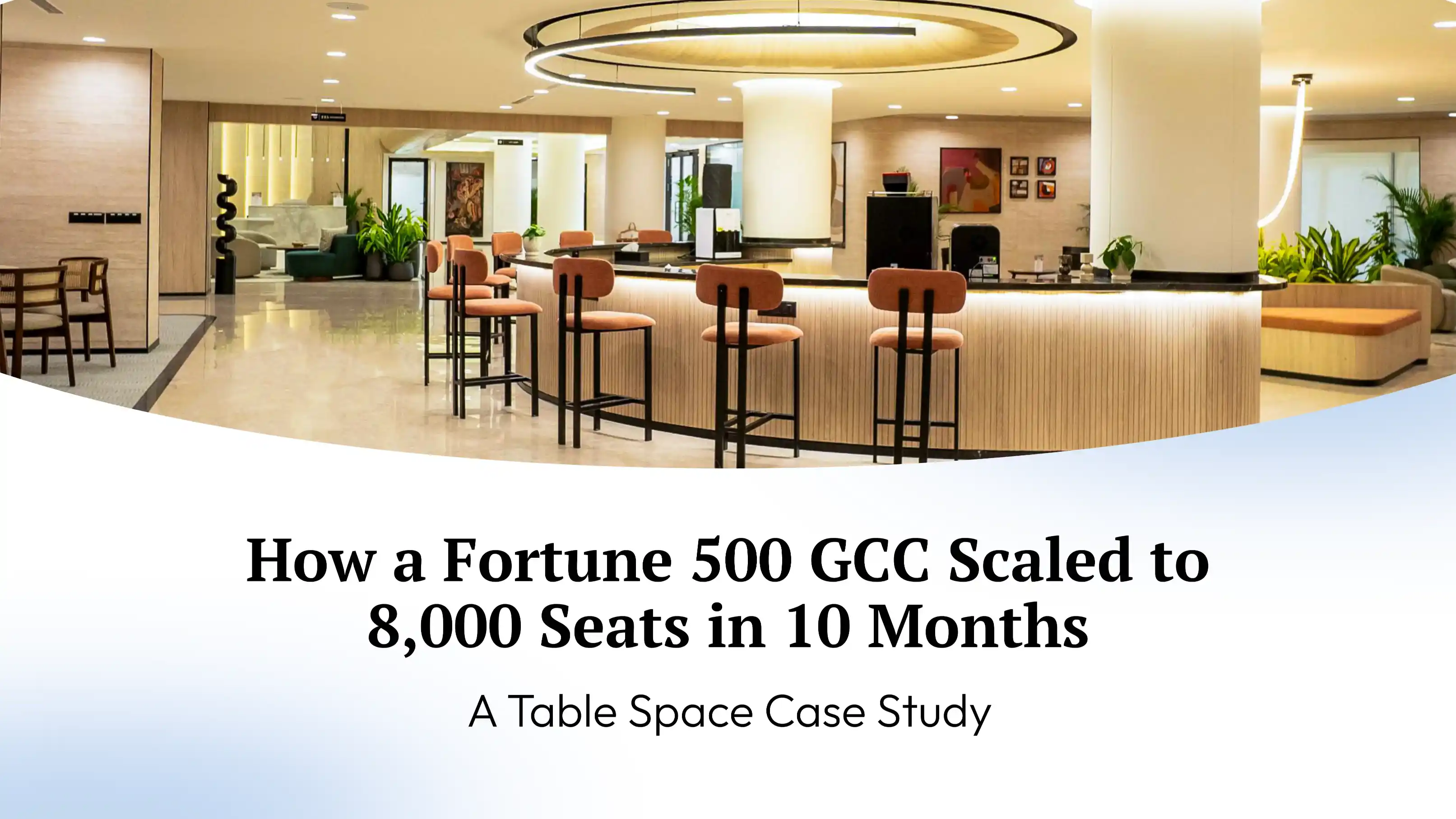
A Table Space case study in multi-city GCC delivery, compliance consistency, and the operating model that made sequential procurement unnecessary.
The decisions made at the outset of a GCC office programme in India – on workspace model, provider accountability, and compliance structure – determine whether the operation is ready to hire at scale on schedule, or still navigating lease negotiations and vendor disputes six months after the intended go-live. The following case study is drawn from a multi-phase GCC engagement delivered by Table Space across three Indian cities over a ten-month period. It is included here because the conditions under which it was delivered – simultaneous multi-city expansion, non-negotiable global compliance standards, and an accelerated hiring timeline – are representative of the brief most Fortune 500 GCCs bring to India at scale.
This is for GCC directors, heads of real estate, and CFOs at multinationals planning India expansion who need to understand what successful, multi-phase delivery looks like with verified numbers attached.
The Brief: Speed, Security, and No Compromise on Compliance
The engagement began as a pilot location. A global Fortune 500 GCC in the technology sector required a workspace that met its global IT and security standards, in a Grade A building, on an accelerated timeline, without requiring the client to manage the lease, construction, or post-handover operations independently. The compliance requirements were not negotiable. The client’s global standards for network security, physical access controls, and IT infrastructure apply uniformly across every office in their portfolio, and any workspace solution had to meet those standards as a built-in output of the build process.
The business timeline did not permit a conventional lease and fitout sequence.
The Challenge: Consistent Delivery Across Every City, Every Phase
As the India operation validated and headcount grew, the challenge evolved from single-city delivery to consistent multi-city execution at pace. The client required identical compliance and IT standards across every new location, delivery timelines that would not disrupt the hiring ramp in each city, and a single accountable partner across all locations – removing the requirement to run a fresh procurement cycle, onboard a new provider, and re-specify compliance standards each time expansion entered a new city.
Under a conventional multi-vendor model, each new city would have required site selection, lease negotiation, design, construction, and operations processes running independently and sequentially, each taking twelve to eighteen months, each introducing its own vendor coordination overhead and compliance exposure.
The Approach: One Framework, Every City, Every Phase
Table Space managed the full lifecycle for every location across all phases: site identification, lease negotiation, design, construction, IT and security integration, and post-handover operations. The compliance brief established at the pilot location was carried forward as the governing standard for every subsequent location – no re-specification, no new vendor onboarding, no compliance gap between cities.
Table Space’s team worked directly with the client’s global IT and security functions to ensure audit readiness from day one of occupancy at every site. The growth arc moved from the initial pilot, through within-city expansion, and then into additional cities – ultimately reaching approximately 8,000 seats across three cities in under ten months. Each new location was delivered within 75 to 90 days of sign-off. Each met the client’s global compliance and brand standards without exception. None required a fresh procurement cycle.
Table Space’s procurement network – built across 2 to 3 million sq ft of annual delivery with more than 1,250 pre-qualified suppliers and forward rate contracts on standard materials – gave the client access to pricing and parallel delivery capability that a single-project enterprise cannot independently achieve.
The Outcome
Cost outcomes across every phase were consistently 15 to 20% below the client’s internal benchmarks for a self-managed build-out of equivalent specification. There were zero operational gaps between phases. Each location was ready to hire from day one of occupancy, with compliance infrastructure fully operational before the first employee arrived.
The single-provider model also eliminated a category of risk that multi-vendor expansions carry by default. For an organisation operating under global audit requirements, a compliance gap in one city creates exposure across the entire India portfolio. Consistent delivery under one framework, to one standard, across every location, removed that risk entirely.
Three Principles from This Engagement That Apply Across Sectors and Seat Counts
The workspace model decision made at the pilot stage determines the scalability of the entire GCC programme. A managed office framework that functions at a few hundred seats can be extended to thousands without re-procurement, re-specification, or operational disruption – provided the framework was structured for that extension from the outset.
Compliance built into the delivery framework from the first location is the only reliable approach for enterprises with active audit requirements. Retrofitting compliance infrastructure post-occupancy is more expensive, more disruptive, and for enterprises operating under SOC2, ISO 27001, or GDPR, frequently inadequate to meet the standard.
The 75 to 90 day delivery timeline is a function of parallel workstreams, a pre-qualified supplier network, and a provider that has already absorbed the learning curve that would cost a first-time enterprise nine to eighteen months on its own. That timeline advantage compounds across every additional city in the expansion.