
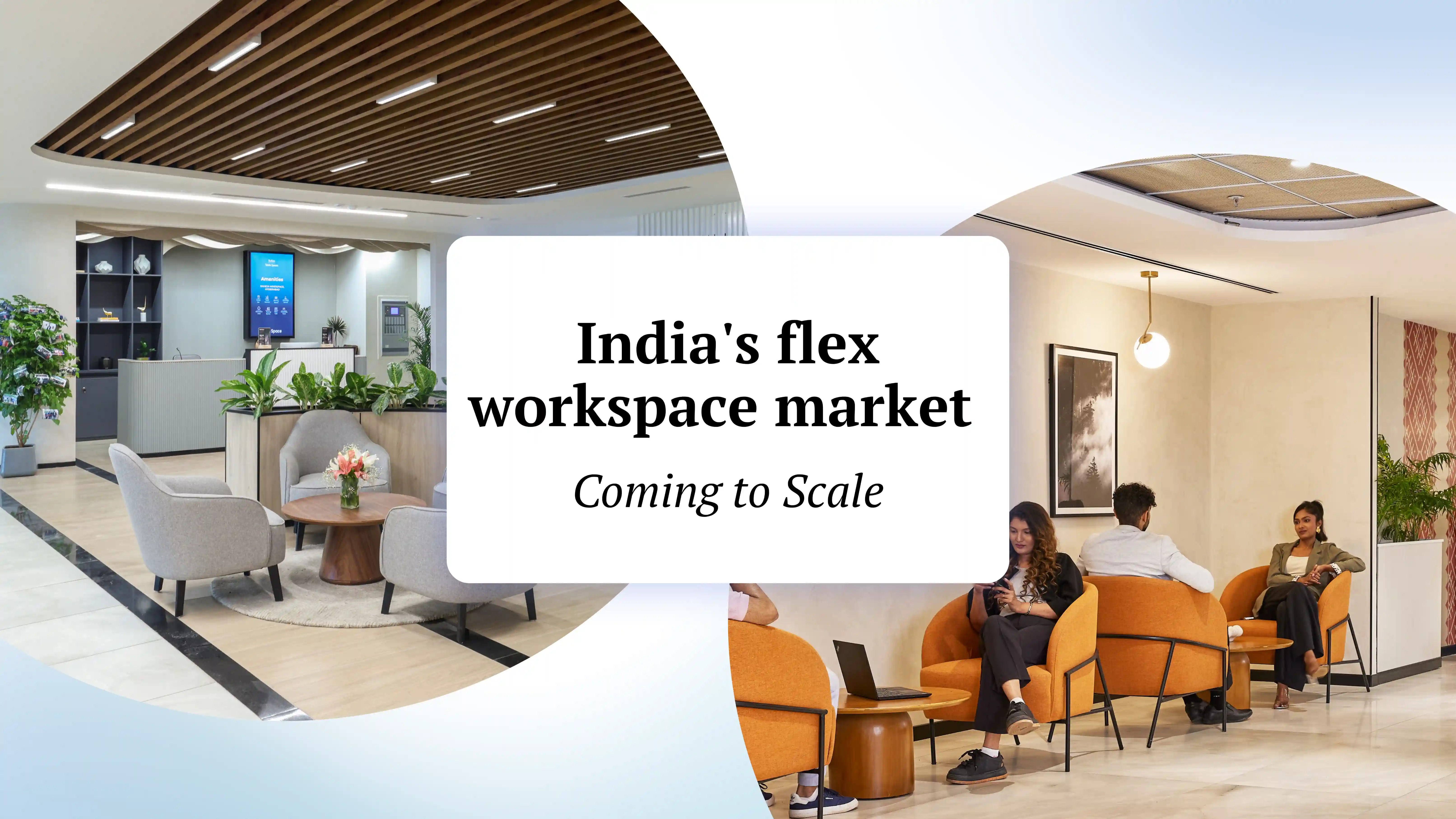
India’s flex workspace sector has crossed a landmark milestone, with total stock surpassing 110 million square feet and enterprise demand at record levels. This piece maps the market, the players building it, and what the next phase demands.
How Big Is India’s Flex Workspace Market Today?
India’s flexible workspace market has crossed the 100 million square foot milestone, with total stock now at 110-114 million square feet spread across approximately 2,600 centres nationwide. The sector has grown at a CAGR of 23-25% over the past five years, tripling in size since 2020, according to a joint report by CBRE and FICCI. The top 10 operators alone control approximately 67% of total stock, according to Vestian Research.
The market is valued at approximately USD 6 billion in 2025 and is projected to reach USD 11+ billion by 2030, growing at a CAGR of nearly 14%. There are now over 500 flex operators active across the country.
Bengaluru leads with 30-32 million square feet of operational flex stock, representing the largest single market in the country. Delhi NCR follows with 21-23 million square feet, and Pune has the highest flex penetration of any major city at 14-16%, supported by 13.6-14.6 million square feet of stock. Chennai remains among the fastest-growing markets, having expanded its flex footprint more than fivefold since 2021.
Stats: 110-114M sq ft of operational flex stock nationwide | 2,600+ flex centres across India | 23-25% CAGR over five years | ~$6B market value in 2025
What Is Driving Enterprise Demand for Flex Space in India?
The shift in who actually occupies flex space is the defining story of the past three years. Enterprise clients, including corporations, multinationals, and Global Capability Centres, now account for nearly 70% of all flex seat demand in India. In value terms, they represent 54% of total market revenue.
Average enterprise deal sizes have nearly doubled, going from 25 seats per requirement in 2023 to 53 seats in 2025. That reflects a genuine structural change in how companies approach workspace. It is no longer a short-term fix. It has become a long-term operational strategy that offers speed to market, cost efficiency, and the ability to scale without the capital burden of a traditional lease.
Global Capability Centres are a significant part of this story. India now hosts over 1,750 GCC companies across nearly 3,800 bases. More than 475 flex centres in Tier-1 cities currently house GCC operations. GCCs account for 40 to 45% of all enterprise flex demand in 2025, a share projected to approach 50% over the next two years as GCCs continue expanding their India footprint.
Technology and BFSI firms together represent 60 to 65% of enterprise flex demand. Engineering, manufacturing, and consulting sectors are expected to grow their share noticeably over the next two to three years.
Flex operators are increasingly offering “GCC-as-a-Service” models that cover everything from location planning and regulatory approvals to workspace deployment aligned with global standards. For global firms entering or expanding in India, this model removes the friction of local real estate navigation entirely.
India’s Largest Flex Workspace Operators, Ranked by Operational Portfolio Size
Realty+, one of India’s leading real estate publications, recently published a ranking of the country’s biggest flex workspace players by operational portfolio size. Portfolio size, measured in square feet, is a meaningful metric at this stage of market maturity. It reflects leases signed, capital deployed, and enterprise-grade capacity that is operational today, not just projected.
|
|
Operator |
Portfolio Size |
Origin |
|
1 |
Table Space |
11-12 mn sq ft |
India |
|
2 |
Smartworks |
10 mn sq ft |
India |
|
3 |
WeWork India |
8.2 mn sq ft |
Global |
|
4 |
Awfis |
8-8.5 mn sq ft |
India |
|
5 |
IndiQube |
6-7 mn sq ft |
India |
|
6 |
IWG |
5-6 mn sq ft |
Global |
|
7 |
Incuspaze |
4-5 mn sq ft |
India |
|
8 |
BHIVE Workspace |
2+ mn sq ft |
India |
|
9 |
Cowrks |
1.8+ mn sq ft |
India |
|
10 |
The Executive Centre |
1.5+ mn sq ft |
Global |
Source: Realty+ Flex Workspace Rankings, 2026. Portfolio figures represent operational sq ft.
Why Do Indian Operators Lead the Rankings Over Global Brands?
Six of the top ten operators by portfolio are India-origin businesses. WeWork, one of the most recognised flex workspace brands in the world, ranks third. IWG, the world’s largest flex operator by number of locations, sits sixth. This is not a fluke or a data quirk.
Indian operators built their businesses with a deliberate focus on the enterprise and GCC segment, the Grade A office corridor, and the specific operational requirements of multinational clients expanding in India. That focus, held consistently over nearly a decade, has produced portfolio sizes that global brands with far higher name recognition have not come close to matching in this market.
It also comes down to market understanding. The Indian commercial real estate landscape has its own geography, its own landlord dynamics, and its own enterprise procurement behaviour. Operators who worked through all of that from the inside, rather than importing a global playbook, ended up capturing the bulk of institutional demand.
What a 110-114 Million Square Foot Market Means for What Comes Next
According to CBRE and FICCI’s report “Flex-plosion: India’s Flexible Workspaces Era,” India’s flex stock has already crossed the 100 million square foot milestone, reaching 110-114 million square feet in 2025, well ahead of earlier projections. The sector grew at 23-25% annually over five years, and the structural drivers show no sign of easing.
On the demand side, average annual enterprise seat uptake is forecast to reach 200,000 seats in both 2026 and 2027, a 25% increase over current levels. GCC demand is expected to account for nearly 50% of all enterprise seat take-up within this period. Nearly 65% of office occupiers in India expect to integrate flexible workspaces into their portfolios by 2027, up from 55% today.
This is not a market coasting on momentum. Serving a 500-seat GCC requirement, or a phased enterprise rollout across three cities, demands operators with the infrastructure depth, Grade A building relationships, and operational sophistication to deliver without friction. The consolidation already visible in the top-10 rankings is likely to deepen. The gap between the largest operators and the rest, measured in millions of square feet, is not easily closed. In a market where enterprise clients make long-term decisions, track record and scale work as genuine competitive advantages.
Stats: 110-114M sq ft flex stock today | 200K enterprise seats forecast annually in 2026-27 | ~50% of enterprise demand from GCCs by 2027 | 65% of occupiers plan flex adoption by 2027
Which Operators Are Best Positioned for the Next Phase of Growth?
The next phase of India’s flex market will not be decided by brand visibility or marketing spend. It will come down to execution. A 500-seat GCC deployment, a phased multi-city enterprise rollout, or a managed office for a global technology firm leaves no room for operational gaps. Scale, asset quality, and infrastructure depth are not optional extras at this level.
Three things will separate the operators who lead the next phase of growth from those who do not. First, access to Grade A buildings: 70% of recent flex uptake has been concentrated in green-certified developments, driven by the ESG mandates of enterprise and GCC clients. Operators without Grade A, sustainability-compliant inventory will find themselves locked out of a growing share of enterprise demand. Second, multi-city operational capability: as GCCs and enterprises standardise their workspace approach across locations, they will gravitate toward operators who can deliver consistently across cities rather than in just one. Third, managed infrastructure: the shift toward “GCC-as-a-Service” and fully managed office models means operators need more than square footage. They need the technology integration, compliance capability, and service infrastructure that global occupiers expect as standard.
The current rankings reflect who built correctly in the last cycle. The operators who hold and extend those positions over the next two years will be the ones who meet the enterprise segment’s requirements at the scale it now operates.
Table Space has built its business on a single conviction: that India’s enterprise and GCC workspace needs would eventually demand infrastructure at institutional scale, Grade A, multi-city, fully managed, and built for the long term. The market data and the rankings both point to that conviction having been right. The work now is to keep building for what comes next.
Sources: CBRE and FICCI, “Flex-plosion: India’s Flexible Workspaces Era” (March 2026) · Vestian Research, Flex Workspace Report (December 2025) · Realty+ Flex Workspace Rankings (2026) · Mordor Intelligence, India Flexible Office Space Market (2025)
