

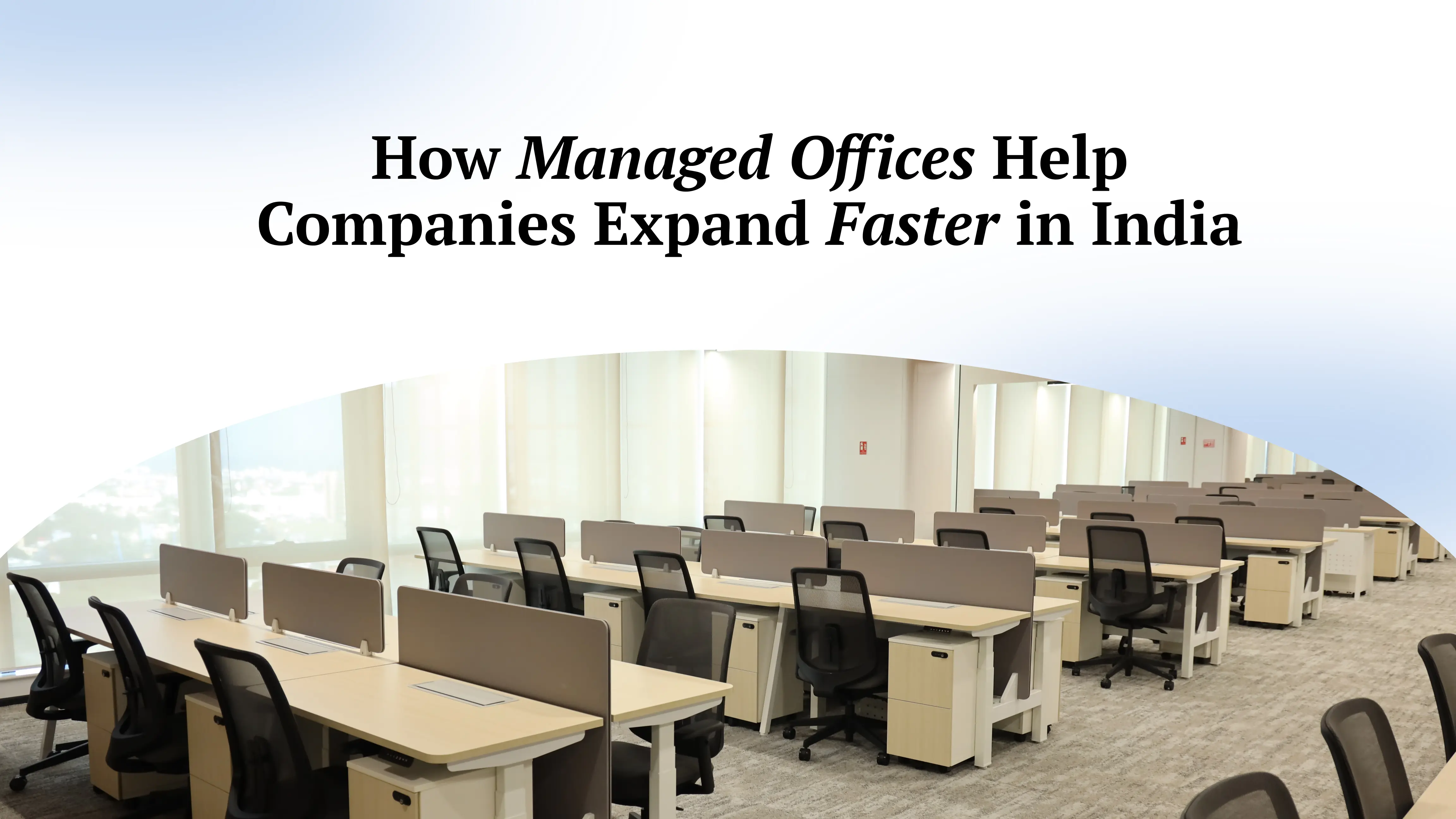
Coworking gave global enterprises a fast, low-risk entry point into India. For thousands of companies, it was exactly the right call. But as teams grow, mandates expand, and India operations move from pilot to permanent, the requirements change. This piece is about what that transition looks like, why it happens, and how to know when the time is right.
This information is for GCC directors, global workplace leads, and operations heads at multinationals whose India operations have scaled past the point where coworking was originally chosen. If your team has grown, your compliance obligations have deepened, or your India presence has shifted from exploratory to strategic, this piece covers what comes next and why.
The CBRE-FICCI Flex-plosion report (March 2026) documented that 55 to 60 percent of India's total flex demand now comes from global companies. The Cushman and Wakefield research co-published with Table Space (2024) identified the underlying driver: as enterprises scale, they want one accountable partner to manage the full real estate lifecycle. That is a different brief from the one coworking was designed to serve.
Why Coworking Is the Right Starting Point for India
Fast setup, low commitment, operational from day one.
When a global company first enters India, coworking is frequently the most disciplined real estate decision it can make. The team is small, headcount projections are uncertain, and committing to a long-term lease before validating the market is poor capital allocation. Coworking provides a professional, operational base with no fit-out capital, no long-term commitment, and no requirement to build an internal real estate function before the business is ready for one.
For GCCs at the proof-of-concept stage, coworking in Bengaluru, Hyderabad, or Pune offers access to Grade A infrastructure, a professional environment for early hires, and the flexibility to scale the footprint up or down as the model is validated.
It is the right tool for that stage. The question is recognising when the stage has changed.
Coworking earns its place at market entry. The transition to managed offices is not a criticism of coworking. It is a sign that the India operation has grown into something more permanent.
What Changes as the Operation Matures?
Three variables shift as an India operation moves from pilot to permanent.
The brief gets more specific. An early-stage team needs a desk and a meeting room. A 200-person GCC running AI mandates or BFSI operations needs a workspace built to its own specifications: its floor plan, its network architecture, its brand environment, its security configuration. Coworking provides shared infrastructure. A managed office provides dedicated infrastructure built for one occupier. PwC's India expansion illustrates this shift exactly: the operation began in coworking-adjacent flex, then moved to a fully customised managed office at Cyber Greens, Gurugram, when the team size, the compliance profile, and the client-visit expectations made a shared environment the wrong structure.
The headcount and the timeline get longer. Coworking works best for teams under 25 with a horizon under 12 months. As headcount crosses 40 to 50 people and the India presence becomes a multi-year commitment, the economics and the operational logic of a dedicated managed office become more favourable than a shared environment scaled up seat by seat.
The compliance profile deepens. As GCCs take on higher-value mandates in engineering, AI, and financial services, the data they handle becomes more sensitive and the frameworks governing it become more specific. A managed office provides the dedicated network perimeter, documented access controls, and auditable physical security that a shared environment structurally cannot. For a BFSI GCC operating under SOC2 or ISO 27001, the compliance disqualifier in coworking is not a preference. It is a hard stop.
The shift is not about coworking failing. It is about the operation outgrowing what coworking was designed to deliver.
What Does a Managed Office Deliver at This Stage?
A workspace built entirely around one occupier's requirements, operated end-to-end by a single accountable partner.
A managed office is a private, fully customised workspace built to one occupier’s specifications and operated end-to-end by a single provider. As an end-to-end managed office provider, the operator enables the enterprise to control the floor plan, the brand environment, the network architecture, and the security configuration. Everything else, fit-out, facility management, IT infrastructure, utilities, sustainability reporting, and a curated employee experience programme designed specifically for that team, consolidates under one monthly fee.
For a GCC that has validated its India model and is ready to commit, the managed office delivers what the next stage requires: a space that reflects the organisation's global standard, supports its compliance obligations, and scales with its headcount without requiring a new procurement cycle each time.
The pattern repeats consistently across sectors and cities. SolarWinds moved from a constrained CBD office in Bengaluru to a larger, future-ready managed workspace in the Extended Business District, with the transition executed on an accelerated timeline and the same provider relationship subsequently extended to Mumbai without a fresh procurement process. BMW Techworks India scaled from 100 seats to 700 in Pune in approximately 120 days, with contiguous Grade A space secured and delivered to global design and compliance standards. American Express set up a 12-month incubation centre in Chennai, designed and built within 90 to 120 days, purpose-built to support their transition to a long-term facility. In each case, the move from a shared or interim environment to a managed office was not a preference. It was the operationally correct response to a changed brief.
The hybrid portfolio, a managed office anchoring the primary city headquarters with flexible workspace serving smaller teams in secondary cities, is now the standard structure for sophisticated GCCs. The CBRE-FICCI report (March 2026) identifies this approach as one of the defining behaviours of enterprise flex adoption in India.
The managed office is not the alternative to coworking. It is what comes next.
How Do You Know When the Transition Is Right?
-
- The team has crossed 40 to 50 people and the shared environment is visibly constrained
- A compliance review or client security assessment has raised questions about shared infrastructure
- Senior hires or client visits to the office are producing a first impression that does not reflect the organisation's global standard
- The India presence has shifted from a pilot to a permanent, multi-year strategic commitment
When these signals appear, the coworking arrangement has served its purpose well. The next step is a managed office that serves the next one.
Table Space operates as a managed office provider for GCCs and multinationals across Bengaluru, NCR, Pune, Hyderabad, Mumbai, and Chennai. With approximately 45 percent repeat business and over 125 GCC clients, the pattern is consistent: enterprises start with a smaller or shared environment, validate the India model, then scale into a purpose-built managed office through the same provider relationship, city after city, without starting the procurement process over each time.