
A clear breakdown of how modern workplace solutions work, what they include, and why large organisations are adopting them at scale.
Flexible workspace solutions for large enterprises go well beyond shared desks. They include managed offices, hybrid portfolios, and technology-enabled environments. As of 2025, 55 to 60 percent of India’s flex demand comes from global companies. This piece explains what each solution is, who it serves, and how to evaluate the right fit.
This information is for GCC heads, real estate decision-makers, CFO’s and operations leaders at multinationals evaluating office options in India. If your organisation is above 50 people, operates under compliance requirements, or is expanding across cities, standard coworking does not fit your brief.
The CBRE-FICCI Flex-plosion report (March 2026) found India’s flexible office stock at 110 to 114 million square feet, growing at 23 to 25 percent CAGR since 2020. Enterprise clients now account for more than half of total flex demand by value.
What Do Flexible Workspace Solutions Include for Large Enterprises?
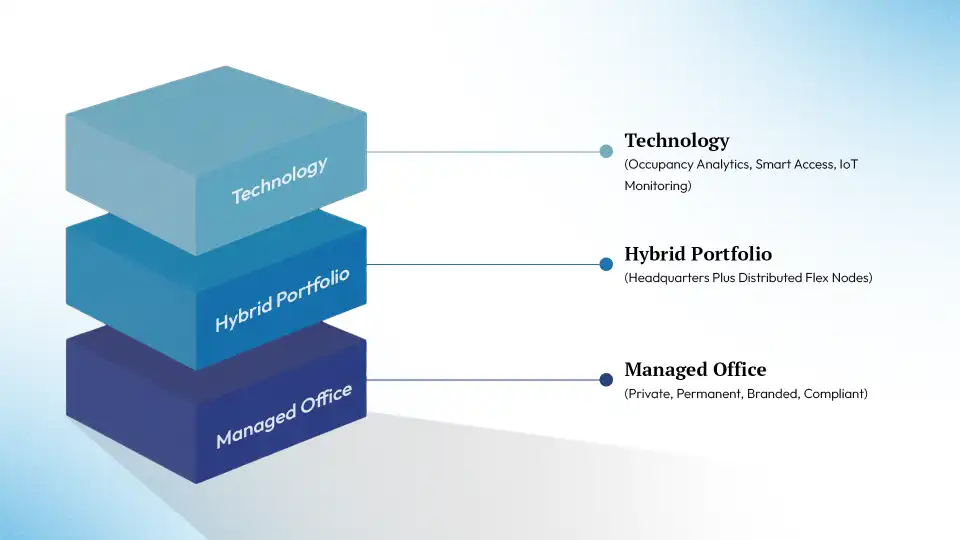
Three distinct models, each serving a different organisational brief.
Managed offices are the primary flexible workspace solution for large enterprises. A managed office is fully private, fully customised, and operated end-to-end by a single provider. The enterprise controls the floor plan, brand environment, network architecture, and security configuration. Fit-out, facility management, IT, utilities, and security fall under one monthly fee. Lease terms run one to three years.
For a GCC entering India, a managed office solves three problems at once: it removes the capital exposure of deposits and fit-out, compresses setup from 18 months to approximately 90 days, and eliminates the burden of managing a fragmented vendor ecosystem.
Hybrid portfolios combine a managed office headquarters with flexible office space or coworking in secondary cities. A technology firm consolidating its India operations in Bengaluru, for example, might anchor its headquarters in a managed office and use coworking for smaller teams in Chennai or Kolkata. The CBRE-FICCI report identifies this portfolio approach as one of the three structural shifts defining the current market.
Technology-enabled workplace management gives leadership real-time visibility into how space is being used. Occupancy analytics, smart access control, and IoT monitoring are now standard components of enterprise flex solutions, allowing organisations to optimise space across multiple locations.
Large enterprises need a combination of all three, not a single model applied uniformly.
Why Are Large Enterprises Moving Away from Conventional Leases?
Conventional leases lock in assumptions that break within two years.
A conventional lease commits an organisation to fixed square footage for five to nine years. It requires six to twelve months of rent as a deposit before a single hire joins. It demands an internal real estate capability most enterprise teams did not come to India to build.
The Cushman and Wakefield research co-published with Table Space in 2024 identified the core driver of managed office adoption: enterprises want one accountable partner to manage the full real estate lifecycle.
The managed office model exists precisely to remove real estate complexity from enterprise leadership bandwidth.
How Should a Large Enterprise Evaluate Flexible Workspace Options?
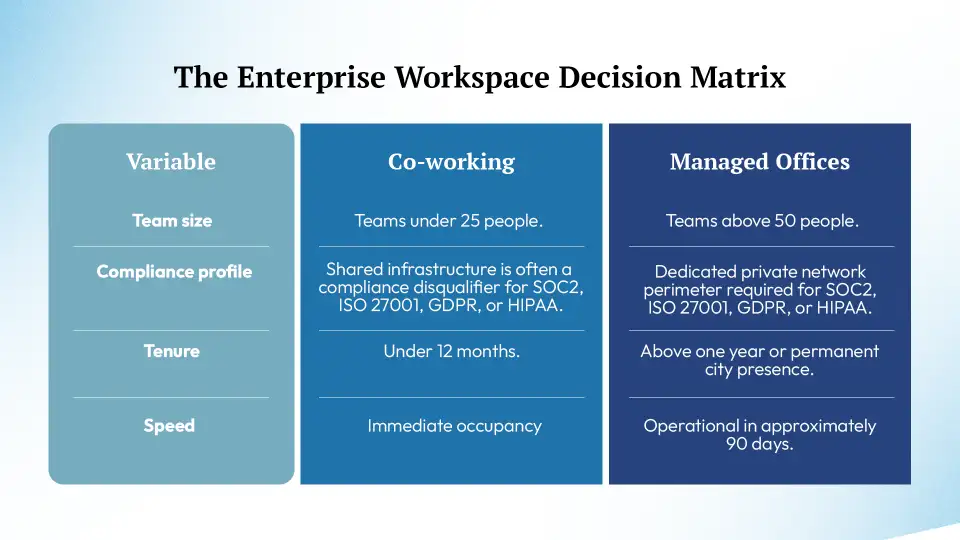
Four variables determine the right model.
Match the model to the variables, not to the headline per-seat cost. And when speed is non-negotiable, managed offices built for enterprise move-in, like those offered by Table Space, mean you do not have to choose between fast and right.
Table Space operates as a managed office provider across Bengaluru, NCR, Pune, Hyderabad, Mumbai, and Chennai, serving over 315 enterprise clients with over 85 percent of revenue from Fortune 500 companies.
Match the model to the variables, not to the headline per-seat cost. And when speed is non-negotiable, managed offices built for enterprise move-in, like those offered by Table Space, mean you do not have to choose between fast and right.
Table Space operates as a managed office provider across Bengaluru, NCR, Pune, Hyderabad, Mumbai, and Chennai, serving over 315 enterprise clients with over 85 percent of revenue from Fortune 500 companies.